- Graduate Field Affiliations
- Applied Information Systems
- Atmospheric Science
- Civil and Environmental Engineering
- Computational Science and Engineering (minor)
- Public Affairs
- Public Health and Planetary Health
- Regional Science
- Sustainable Energy (minor)
- Systems Engineering
Biography
Oliver Gao is the Director of the Cornell Systems Engineering and Howard Simpson Professor of Engineering at Cornell University. A leading scholar and academic innovator, Gao’s work sits at the intersection of environmental health and engineering, sustainability, and systems engineering—where technology, data, and human behavior converge to shape the future of healthy, intelligent communities.
An internationally recognized expert in environmental health and engineering (e.g., urban infrastructure systems, transportation, air quality and exposure risk, and public health analytics), Gao develops computational and systems solutions that integrate engineering, data science, and policy design. His research focuses on advancing climate-smart mobility, low-emission infrastructure, and data-enabled health systems, translating fundamental science into real-world societal impact.
As the Director of the Center for Transportation, Environment, and Community Health (CTECH)—a U.S. Department of Transportation University Transportation Center—Gao leads a multi-institutional consortium uniting engineering, environmental science, public health, and data analytics to drive systems innovation for healthy and sustainable communities.
Gao’s scholarship and leadership have established Cornell as a global hub for systems innovation in sustainability and health. Under his directorship, Cornell Systems Engineering has expanded significantly in scope and influence, launching new professional and research degree programs (Ph.D. in Systems, M.S., and M.Eng. Pathways in Energy Systems, Health Systems Engineering, and Semiconductor, Manufacturing, and Industrial Systems), founding the Ezra Systems Scholars Program, Cornell Systems Summit, Cornell Systems Studio, and raising philanthropic support for the cross-campus Health Systems Engineering Program in partnership with Weill Cornell Medicine.
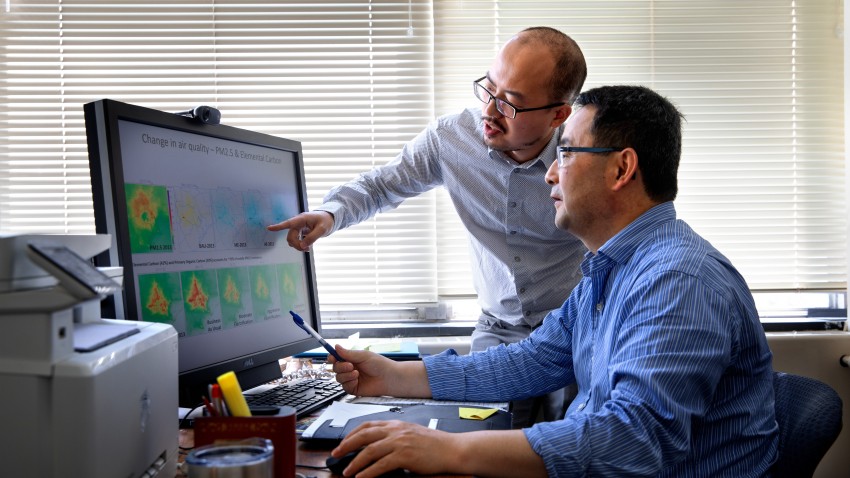
Among Gao Lab’s notable applied innovations is the Cornell Urban Air Quality and Congestion Management System (CU-PPS)—the first web-based platform integrating New York City’s activity-based travel demand and EPA’s MOVES model for multiscale high resolution emissions and air quality/exposure modeling, officially used by New York City and EPA for transportation conformity analyses to ensure compliance with federal air quality standards and safeguard more than 12 million residents across the metropolitan region. The Gao Lab is further developing and bringing the CU-PPS technology and service to other cities faced with similar challenges of traffic congestion, transportation emissions, and environmental/public health. As cities address their aging infrastructure and make important policies, investments, and decisions for smarter cities, Gao stresses that it is a pivotal time for policy makers to also consider how the decisions they make affect the health of the environment and city residents.
Prior to joining Cornell, Gao worked in the mathematical and econometric modeling division of TRG Management LP (The Rohatyn Group), a Wall Street hedge fund specializing in emerging markets, where he developed quantitative models for large-scale systems and financial risk.
Gao has served as Editor-in-Chief of Transportation Research Part D: Transport and Environment and as a reviewer and advisor to multiple federal agencies, including the NSF, EPA, DOE, and DOT. His scholarship, institutional leadership, and translational engagement reflect a unifying vision: advancing the science and systems of sustainable and healthy living for people and the planet.
Service and Leadership Interests:
- Institutional transformation: Building and scaling academic programs and research centers that bridge disciplines, elevate global reputation, and deliver societal impact across scales.
- Systems leadership: Advancing models of entrepreneurship, governance and cross-departmental collaboration inside research institutions.
- Professional service in the systems & infrastructure community: Engaging with organizations, policy forums, and standards bodies that shape systems engineering, transportation-environment-health research and institutional innovation.
- Mentoring faculty and emerging leaders: Developing ecosystems for teamwork, cross-faculty appointments, and leadership pipelines in engineering and systemic innovation.
- Knowledge translation and public engagement: Bridging research, policy and implementation to ensure that systems insights benefit public health, communities, infrastructure, and society.
Research Interests
Gao’s research interests include data science, networks/complex systems, engineering computing, statistics/econometrics, and mathematical optimization & operations research in technology, information, and systems management for Intelligent and Healthy Communities across Scales.
- Technology, information, and management innovation and assessment for clean technology and community health (hybid-diesel electrical technology, alternative fuels, diesel retrofit, congestion pricing)— measurement, integrated modeling, and systems analytics of environment and health impacts from alternative vehicle/engine/fuel technologies and policy innovation
- Blockchain-based verifiability for climate actions in transportation (CATChain) and green supply chain/logistics
- Data science, AI and systems analytics for the planning and management of complex systems/networks: integrated infrastructure and environment/energy systems modeling and advanced decision methodologies (e.g., low carbon and low emission transportation systems; complex systems of coupled transportation, environment and energy networks)
- Cyber-innovation in data-driven high-fidelity digital twins in urban informatics for healthy living in smart & sustainable cities: air quality and exposure modeling, cellular microwave networks for air quality and precipitation monitoring, advanced travelers’ general information systems (ATGIS), and multi-layer cross-domain digital twins (DT) in support of dynamic adaptive decisions under uncertainty and coplexity;
- Cooperative networked built-and-natural environment: Computational infrastructure and environment system sustainability management and optimization for the protection of human health and natural systems; inter-relationship between infrastructure and air quality, multi-scale air quality modeling– linking health risks modeling to air quality, infrastructure investment, and policy
Teaching Interests
- CEE 4650/6650: Transportation systems and air quality planning and modeling
- SYSEN 5300/5310: Systems engineering and six sigma for the design and operation of reliable systems (including Distance Learning)
- SYSEN 5400: Theory and application of systems architecting (including Distance Learning)
- SYSEN 5450: Managing and Modeling Complex Systems for Organizational Leaders
- SYSEN6000: Foundation of Complex Systems
- SYSEN 6100: Ezra Roundtable Systems Seminar Series
Gao believes that teaching and mentoring are about cultivating systems thinkers and doers—engineers and scientists who do more than answer questions; they learn to frame the right questions, understand interconnections, and lead with purpose. In his classroom and advising, he emphasizes experiential learning, interdisciplinary collaboration, and real-world engagement. Gao challenges students to combine analytical rigor with human insight—equipping them to translate complex models into meaningful solutions for impact. As a mentor, he focus on intellectual independence, ethical inquiry, and lifelong learning, helping students—from undergraduates to Ph.D. candidates and post-docs—become innovators and leaders who turn systems thinking into societal good. He seeks to model curiosity, integrity and empathy—the foundations of engineering for people and planet.
Select Publications
-
Luchang Cui, Juhong Lee, Juliet Miller, Minmeng Tang, Sajjad Abedian, Nasser Altorki, Robert S. Crupi, Lauren Groner, Neal Lindeman, Laura Pinheiro, Rulla Tamimi, Jonathan Villena-Vargas, Anil Vachani, Julie A. Barta, H. O. Gao, Evan Sholle1, James P. Solomon, Christine A. Garcia, Eunji Choi, Yiwey Shieh (2025). Design and creation of a racially diverse lung cancer registry with detailed genomic and environmental annotation, Cancer Epidemiology Biomarkers & Prevention
-
Lu, Danni, M. Tyranni, H.O. Gao (2025). Machine learning in spatiotemporal PM2.5 hotspots analysis for better targeted mitigation strategies, Transportation Research Part D: Transport and Environment
-
Zhang, Yiye, M. Tayarani, S. Wang, Y. Liu, M. Sharma, R. Joly, A. RoyChoudhury, A. Hermann, H. O. Gao, J. Pathak (2021) Identifying urban built environment factors in pregnancy care and maternal mental health outcomes, BMC Pregnancy and Childbirth
-
Heo, J., P. J. Adams, H.O. Gao (2016). Marginal and aggregate social costs of primary PM2.5 and inorganic PM2.5 precursor emissions in the United States, Environmental Science and Technology, 50, 6061-6070
-
Nicholson, C., X. He, M. Gómez, H.O. Gao, and E. Hill (2015). Environmental and economic impacts of localizing food systems: the case of dairy supply chains in the Northeastern U.S., Environmental Science and Technology, 49, 12005−12014.
Select Awards and Honors
- Inaugural Howard Simpson Professor of Engineering, School of Civil and Environmental Engineering 2021
- Research Frontiers Nomination, National Science Foundation 2016
- James and Mary Tien Excellence in Teaching Award (Cornell, College of Engineering) 2010
- Nomination: Kendall S. Carpenter Memorial Advising Award (Cornell University) 2010
- University of California Transportation Center Ph.D. Dissertation Award 2004
- NSF Future Engineering Education Scholars (EES) Award 2002
- Nortel Business Plan Competition Award, and IET International Fellowship 1998
Education
- B.S. (Civil Engineering), Tsinghua University 1996
- B.S. (Environmental Science), Tsinghua University 1996
- M.S. (Civil Engineering), Tsinghua University 1999
- M.S. (Statistics), University of California, Davis 2004
- M.S. (Agriculture and Resource Economics), University of California- Davis 2004
- Ph.D. (Civil Engineering), University of California-Davis 2004