The generation of continents and the deep Earth oxygen cycle
Earth’s unique oxygen-rich atmosphere and buoyant continental crust facilitate our planet’s ability to foster complex life. Oxygen fugacity, a measure of the redox capability and chemical potential of oxygen in the solid Earth, varies based on tectonic setting and crust type. Arc volcanoes, the building blocks of the continental crust, produce oxidized Fe-poor magmas with high Fe3+/ãFe ratios compared to the dense, reduced Fe-rich magmas with low Fe3+/ãFe ratios that constitute oceanic crust. It is not yet clear why the compositions of arc magmas differ from those of mid-ocean ridge magmas. In this talk, I will present the results of new projects designed to test whether the unique chemical signature of the continental crust is inherited from crystallization of high-pressure mineral assemblages in deep magma chambers or is instead the product of mass transfer of oxidized materials from the subducting slab.
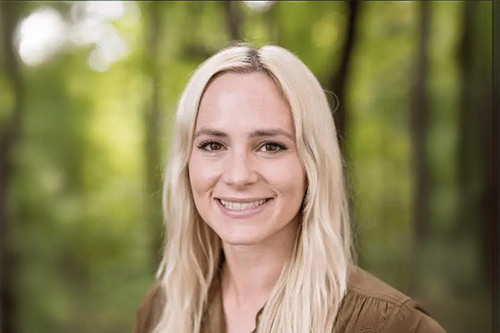
Bio: Megan Holycross joined Cornell’s Department of Earth and Atmospheric Sciences in July 2020 as an assistant professor. Her research seeks to understand the processes that have differentiated the chemistry of Earth’s solid interior, mostly through laboratory experiments. Prior to joining Cornell, Megan was a National Science Foundation Postdoctoral Fellow with appointments at the Smithsonian Institution and Yale University. She earned her B.Sc. from Michigan State University in 2012 and her Ph.D. from Rensselaer Polytechnic Institute in 2017.
Holycross uses controlled laboratory experiments to develop new geochemical tools to quantify the rates (time) and conditions (temperature, pressure, redox state) of magmatic and metamorphic processes. Areas of interest include “crystal clock” diffusion chronometry, trace element partitioning in subduction zone settings, and multi-valent element x-ray absorption near edge structure (XANES) spectroscopy.