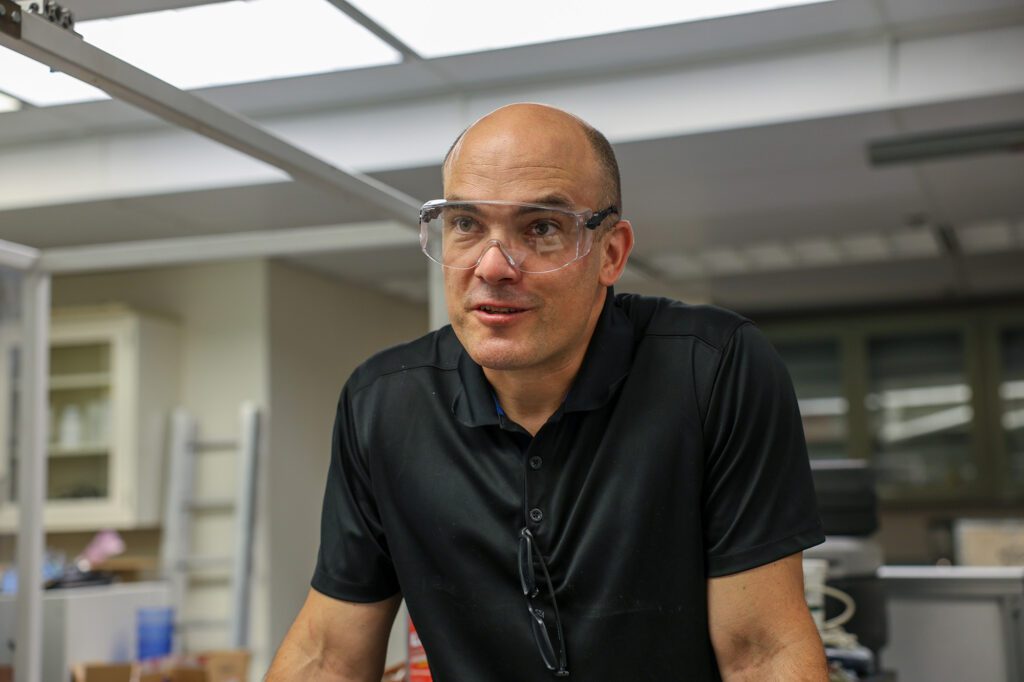
For Tobias Hanrath, newly appointed Croll Professor of Sustainable Energy Systems and director of the Cornell Energy Transition Initiative, the clean energy transition represents an extraordinary opportunity—not just for society, but for chemical engineers to design and scale the innovations that will define the next generation of energy systems. Cornell, he believes, is uniquely positioned to lead this transformation.
With his appointment earlier this year as lead for Cornell Engineering’s research pillar in Engineering Energy Transitions, Hanrath brings a perspective shaped by the belief that bringing laboratory discoveries to fruition requires active engagement in translational activities. His experience demonstrates how chemical engineers can bridge the gap between fundamental research and scalable solutions that address global challenges.
Hanrath’s research focuses on electrochemical systems that can convert CO2 and methane from waste products into valuable chemicals and fuels. His team is developing dynamically responsive catalysts that orchestrate reactions in ways conventional industrial systems cannot—seeking efficiencies that push beyond traditional thermodynamic limits while uncovering new insights into the molecular choreography of reaction mechanisms.
A compelling example of this translational approach is Hanrath’s co-founding of Dimensional Energy, launched in collaboration with David Erickson, director of the Sibley School of Mechanical and Aerospace Engineering. By leveraging breakthroughs in catalysis and materials science, the company transforms carbon dioxide emissions into sustainable aviation fuel. In 2022, United Airlines announced an agreement to purchase at least 300 million gallons of this fuel—demonstrating how academic research, when paired with entrepreneurial translation, can achieve market-scale impact.
Central to Hanrath’s approach is Cornell’s distinctive strength as a living laboratory, where the campus itself serves as a testing ground for energy innovations. From Lake Source Cooling to Earth Source Heat, Cornell has a long history of implementing and scaling energy solutions in real-world conditions, creating invaluable opportunities for research, education and technology development.
Building on this tradition, Hanrath is spearheading the Cornell Advanced Platform for Testing, Utilization, and Research in CO₂ Capture and Conversion (CAPTURE-Lab), a mobile facility that will operate next to Cornell’s Combined Heat and Power Plant. Supported by the Cornell Atkinson Center for Sustainability, it will enable faculty across disciplines to analyze gas emissions, test capture materials, and evaluate conversion technologies—bridging fundamental science and lab-to-market feasibility.
“One of our unique advantages is that, at a place like Cornell, which is big and has a wide range of fields and disciplines, there are a lot of great minds,” Hanrath said. “There are real opportunities at the intersections. My approach is to ask: What are people passionate about on campus? What is the collective skill set that we have?”
By fostering collaborations that maximize real-world impact, Hanrath aims to position Cornell, and chemical engineering in particular, as leaders in the global energy transition. Through the Cornell Energy Transition Initiative, he envisions Cornell as both a catalyst and a proving ground for innovations that address one of society’s greatest challenges—and greatest opportunities.