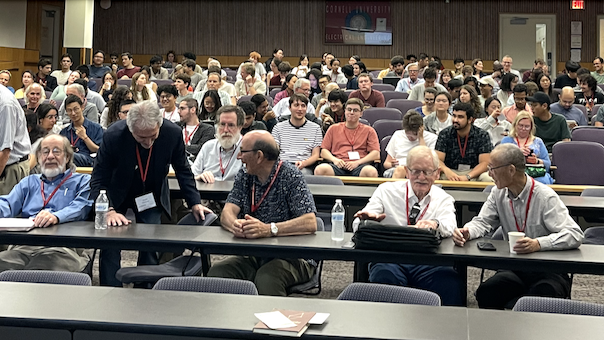
In September of 2024 Cornell’s School of Operations Research and Information Engineering hosted two events to honor the lives and legacies of Uma Prabhu and Ray Fulkerson, both former professors who left a lasting impact on the school and the field. To commemorate the centennial of their births, the school brought together family, students, colleagues and friends on successive weekends for talks, food and reminiscing.
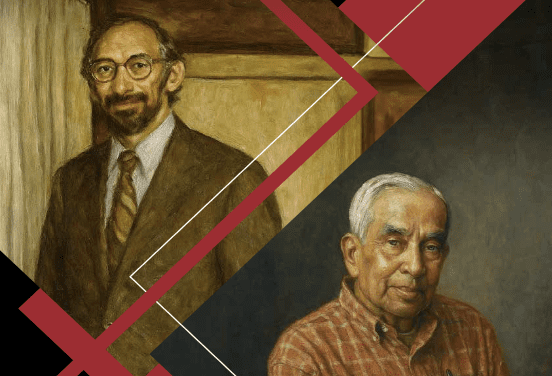
The Uma Prabhu Centennial Conference – September 13-14, 2024
Professor Narahari Umanath (Uma) Prabhu passed away in October 2022 at the age of 98. During his long and distinguished career, much of which was spent at Cornell, Prabhu contributed tremendously to the fields of queueing theory and applied probability. He was also instrumental in the process of building the school into the powerhouse of both teaching and research it remains today.
Prabhu joined the Cornell faculty in 1965 at the age of 41. He had been living in Perth, Australia, and teaching at the University of Western Australia, when a book he wrote, “Stochastic Processes: Basic Theory and Its Applications,” found its way to Frank Spitzer, the late Cornell mathematics professor. Spitzer was greatly impressed by the book and gave it a rave review. The two men started writing to each other and eventually Spitzer recommended Prabhu for a job teaching at Cornell in what was then called the Department of Industrial Engineering. The two remained close friends until Spitzer’s death in 1992.
“Uma came to the school when it was very young, and he was one of the people who made it what it is today: one of the leading departments anywhere in the world,” said Gennady Samorodnitsky, the Charles W. Lake, Jr. Professor in Productivity. “He loved the school and was a mentor to many of the junior faculty members well before the position of mentor came into existence. The school, Cornell, and the science of applied probability lost a great colleague and a great friend when Uma passed away.”
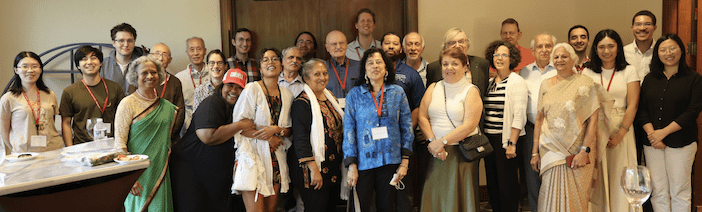
Samorodnitsky, along with professors Jim Dai and David Goldberg, served as the organizing committee for the Uma Prabhu Centennial Conference. The event felt in some ways like an extended family reunion, with Uma’s daughters and granddaughters joining many of his academic family for a series of talks, meals and a reception, all with the guiding purpose of remembering and celebrating Prabhu the man and the mathematician.
Many speakers talked about Prabhu’s intellectual and personal generosity. In the time before email, Prabhu was a prolific letter writer, corresponding with academics around the world. Often he would ask if they had any students who would like to come to Cornell to work with him. And when students did come to Ithaca, Prabhu and his wife Sumi would host them, even inviting others from the guests home country over for dinner so that the guest had a chance to speak their own language far from home.
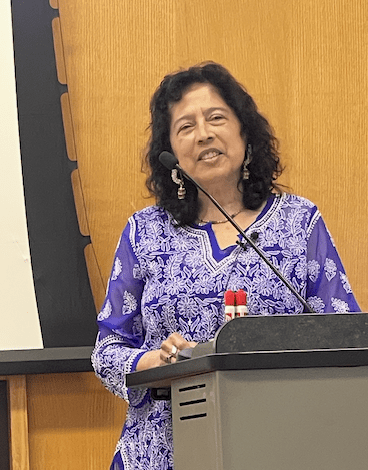
Fittingly, the conference was opened by Prabhu’s eldest daughter, Vas Prabhu. She spoke several times during the conference, remembering her father as an art lover, a collaborator, a pen pal, a generous host and a storyteller. “When we were young girls, my father told my sister and me a multi-part improvisational story many nights at bedtime,” Vas Prabhu recalled. “It was about a family of birds and he would draw a face on his thumb and then wrap a handkerchief over his hand to play the part of the mama bird. He had us laughing and crying during this nightly ritual – always leaving us wanting more story.”
One of Prabhu’s granddaughters, Aliyah Prabhu, read a Yehuda Amichai poem beloved by her grandfather. Together, attendees painted a picture in words of a loving father, a gifted mathematician, a dedicated teacher, and a generous mentor and colleague.
Invited Speakers:
- Soren Asmussen, Aarhus University
- Onno Boxma, Technical University Eindhoven
- Ton Dieker, Columbia University
- Bharat Doshi, Johns Hopkins University
- Michel Mandjes, University of Amsterdam
- Masakiyo Miyazawa, Tokyo University of Science
- Antonio Pacheco, Lisbon Institute of Science and Technology
- Jamol Pender, Cornell University
- Vidayanathan Ramaswami, Statmetrics
- Sid Resnick, Cornell University
- Ziv Scully, Cornell University
- Amy Ward, University of Chicago
The D.R. Fulkerson Centennial Celebration – September 20-21, 2024
In 1976, when Delbert Ray Fulkerson died unexpectedly at the age of 51, it came as a shock to his many friends and colleagues. Fulkerson had been at Cornell for just five years as the Maxwell M. Upson Professor of Engineering and professor of operations research and applied mathematics and had very quickly become an intellectual leader of the department.
Shortly after his death some colleagues wrote a memorial statement that included this paragraph:
“He taught a popular sequence of courses in network flows and extremal combinatorial problems designed to bring research students to the frontiers of knowledge in these areas. Ray was a superb and inspiring teacher. He set very high standards for his graduate students as he did for himself; in his relationships with them he was always fair and compassionate. His door was open to faculty and students alike, and he was a font of knowledge in his areas. He was a scholar in the true sense of the word and continued to produce outstanding research at the frontiers of his field.”
Almost 50 years later, these same themes were evident as some of Fulkerson’s students, peers and friends gathered to celebrate 100 years since his birth in 1924 in Tamms, Illinois.
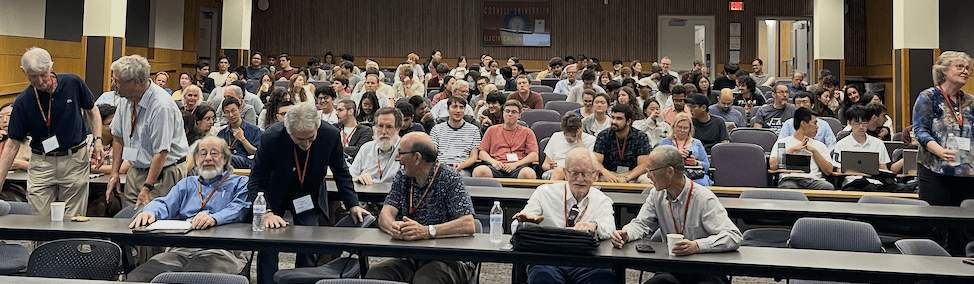
The Centennial Celebration program started with a general-audience public lecture delivered by MIT’s Thomas Magnanti highlighting the formative achievements of Fulkerson and his collaborators on foundations of both pure and computational mathematics in several important areas, as well as the profound real-world impact of Fulkerson’s work. During the two-day event this talk was followed by three technical surveys that described progress in key areas to which he contributed: discrete optimization via integer programming; network flows; and extremal combinatorics, perfect graphs and related polyhedra.
The Fulkerson event was organized by Cornell’s School of Operations Research and Information Engineering faculty members David Shmoys, Robert Bland and David Williamson, who invited collaborators, students, colleagues of Fulkerson and the subsequent generations of scholars in these areas whose work has been influenced by this foundational work.
The talks were not only about mathematics. The organizers and the speakers shared many personal remembrances throughout the event. Robert Bland, professor emeritus, was a doctoral advisee and friend of Fulkerson. While introducing a talk, Bland took a few minutes to tell some stories about Fulkerson. He talked about sharing an office with other doctoral students and how Fulkerson would sometimes walk down the hall and join them in conversation. “He would take a seat and if we were having a discussion he would wait until he saw a conversational on-ramp and join in the discussion,” Bland said. “Often he would ask us a math question he had been puzzling over and it was heady stuff for this great mathematician to be treating us as colleagues. We loved it.”
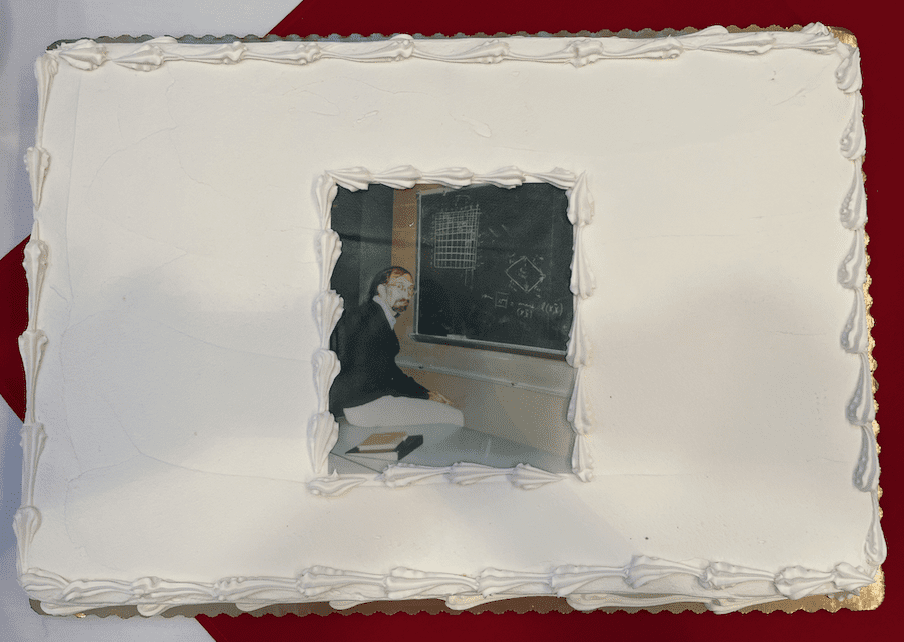
When Fulkerson passed away in 1976 a memorial service was held in the chapel at Cornell’s Anabel Taylor Hall. Fulkerson’s friend, the mathematician Alan Hoffman, said, “His greatest honor is simply that network flows exists as a subject of such importance that all over the world now and in the future, it is and will be a fundamental tool in economic and industrial planning. It was Ray’s great good fortune or perhaps the reward of his talent and energy to create mathematics that contribute to life where art and nature imitate each other.”
This Centennial Celebration honoring the life and legacy of Fulkerson makes it clear that Hoffman was right. Fulkerson the mathematician and Fulkerson the man are still honored and celebrated.
Invited Speakers
- Tom Magnanti, Massachusetts Institute of Technology
- Karla Hoffman, George Mason University
- Ted Ralphs, Lehigh University
- Andrew Goldberg, Lehigh University
- Gerard Cornuejols, Carnegie Mellon University