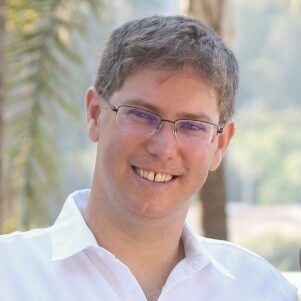
Shoham Sabach has always loved mathematics. “I’m a mathematician,” he said simply. “I’m very happy with the title of applied mathematician.” Yet what excites him most are the places where elegant mathematical theory meets practical impact—where proofs evolve into algorithms that solve real-world problems.
Sabach, who joined Cornell’s School of Operations Research and Information Engineering in 2025 as an associate professor, focuses on optimization theory and its broad applications in data science and artificial intelligence. His research blends rigorous mathematics with the messy complexity of real systems—exactly the mix that defines modern operations research.
“During my early years I was proving theorems just for the beauty of the mathematics,” he said. “But at some point I asked myself, why am I proving this? What happens tomorrow? Who benefits from this result?” That question led him away from pure math and toward optimization—an area that now underpins nearly every discipline from machine learning to economics.
After completing his Ph.D., Sabach moved into a postdoctoral position in Tel Aviv University with Marc Teboulle, a well-known mathematician working on optimization algorithms at the interface of theory and applications.
The first time they met in February 2012, Teboulle pitched to Sabach a research topic that took less than a minute to describe and that Sabach found very interesting. The topic was efficient algorithms for Non-negative Matrix Factorization, which enables the extraction of meaningful latent features from high-dimensional data, making it invaluable in fields like image processing, text mining, and bioinformatics.
This project developed into a highly efficient algorithm called PALM, with theoretical guarantees that were previously unattainable. The paper describing PALM, “Proximal alternating linearized minimization for nonconvex and nonsmooth problems,” was written with co-authors Jérôme Bolte and Marc Teboulle and was published in 2014 in the journal Mathematical Programming. In 2017 the trio was awarded the SAIG/Optimization Prize, which is awarded to the authors of the most outstanding paper on a topic in optimization published in English in a peer-reviewed journal within the four calendar years preceding the year of the award.
In 2014, Sabach joined the faculty of the Technion, most recently in the Faculty of Data and Decision Sciences. But in 2022 he took a leap: a sabbatical in industry. He joined Amazon Research to apply optimization at scale and to learn how cutting-edge mathematics interacts with large-scale AI systems. “I wanted to jump into the deep water and see how optimization works in real life,” he said. What began as a one-year sabbatical turned into a three-year stay, as the explosion of large language models and reinforcement-learning applications made his expertise invaluable.
“At Amazon I learned that the motivation behind the math is just as important as the math itself,” he said. “Industry moves fast, and you see immediately which ideas can scale and which cannot. That experience strengthened my belief that the best research lives at the intersection of theory and application.”
At Cornell, Sabach plans to continue building that bridge. His group will focus on new optimization frameworks motivated by AI and data-driven decision-making, including reinforcement learning, where he sees vast untapped potential. “Optimization already underlies so much of machine learning,” he said. “But I believe we can design methods that are even better tailored to the structure of these problems.”
Sabach looks forward to collaborating across Cornell Engineering and mentoring the next generation of optimizers. “I always tell my students: never stop being curious. Stay a student your whole life. That’s how you keep learning—and that’s how you make discoveries that matter.”