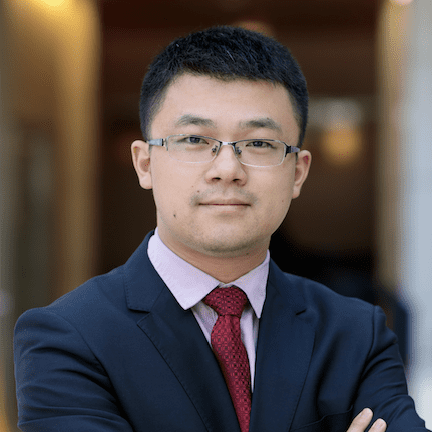
Linwei Xin has joined Cornell Engineering’s School of Operations Research and Information Engineering as an associate professor. Xin’s work combines mathematical rigor, business insight, and curiosity about how artificial intelligence can transform the way goods move around the world.
Xin grew up in Guilin, in southern China—a city famous for its limestone mountains and winding rivers. “It’s a tourism city. There’s even a chapter about Guilin in the elementary school textbooks,” Xin said. Though surrounded by natural beauty, Xin’s imagination gravitated toward mathematics. “I wasn’t good at literature,” he said. “So I focused on math, and I enjoyed it.”
Xin earned his bachelor’s degree in pure mathematics in China before moving to the United States for graduate studies at Georgia Tech. There, his interests evolved toward applied mathematics and optimization. “I started in a math Ph.D. program,” he said, “but my advisor left, so I had to find a new direction. Operations research felt like a natural fit because it’s mathematical, but it also connects to real applications.”
Xin completed his Ph.D. at Georgia Tech under the supervision of David Goldberg and Alex Shapiro, whose mentorship, he said, helped shape his research path. “Operations research was perfect for me,” Xin said. “It allowed me to keep the depth of mathematics but also see how the tools can make real systems more efficient.” (Goldberg himself joined the Cornell faculty in 2017.)
After earning his doctorate, Xin joined the faculty at the University of Illinois at Urbana-Champaign and then moved to the Booth School of Business at the University of Chicago. At Booth, his research bridged operations management and data science, focusing on algorithms and models that help companies manage complex supply chains and inventories. “My work tries to use AI to improve supply chain efficiency,” Xin said. “That means designing models and algorithms that can help companies make better, faster decisions.”
One example of this research involved international e-retailer JD.com, whose warehouse operations closely resembled those of Amazon. “They have robots in their warehouse,” Xin explained. “Traditionally, human pickers walk around to collect items and return to packing stations, which takes a lot of time. Now, robots do the walking. The question becomes: how do you dispatch which robot to which task, in real time? That’s what our algorithms help determine.”
Xin has also worked on deep learning approaches to inventory management at Alibaba Group—developing algorithms that help retailers decide when and how much to restock thousands of products. “For companies like Alibaba, Walmart or Amazon, managing all that inventory efficiently is a huge challenge,” he said. “AI can help them anticipate demand and make smarter decisions.”
His interest in supply chains often leads him to observe real-world shifts closely. A recent paper, he said, was inspired by Amazon’s decision to “regionalize” its distribution network. “They used to ship anything from anywhere, but that created inefficiency,” Xin said. “Now they try to fulfill orders regionally, which shortens delivery distances but sometimes increases waiting time. We discovered something interesting: sometimes, chasing perfect customer satisfaction can hurt efficiency. If a company relaxes just a little—say, a few orders arrive slightly late—its operations can become much smoother overall.” That tradeoff—between efficiency and customer satisfaction—is something Xin find fascinating.
At Cornell, Xin is continuing to explore the intersection of artificial intelligence and operations research. His group focuses on AI-driven optimization for logistics, and he is particularly intrigued by large language models and their potential applications. “Right now I’m thinking about how large models like ChatGPT might automate parts of the optimization process itself,” he said. “Traditionally, humans define the variables and objective functions for a problem. What if AI could help with that too?”
Related to this, Xin has published a paper showing how LLMs can automatically set up dynamic programming (DP) problems, a step that could one day make AI tools that help students learn and practice how to formulate DP problems more effectively.
Xin is also pursuing a more personal AI project—building a chess-playing model that not only recommends moves but explains them. “My daughter has been playing chess for several years, and I’ve learned a lot about it,” he said. “We already have strong engines that tell you the best move, but they can’t explain why. I want to build an AI that can.”
In his first semester at Cornell, Xin is teaching a Ph.D. seminar on large language models. Next semester, he will teach a Data Science course for undergraduates. “Teaching something close to my research is always motivating,” he said. “I’m also learning alongside the students.”
Outside of work, Xin spends his time with his wife and two daughters. They’ve quickly settled into Ithaca life. “They’re happy so far—the weather has been great,” he said with a laugh. “We’ll see after winter.”
Xin hopes his lab will attract students who combine strong mathematical training with curiosity about real-world problems. “I look for people with a solid math background, who work hard, and who are interested in applications,” he said. “That’s the kind of student who can bridge theory and practice—and that’s where real innovation happens.”