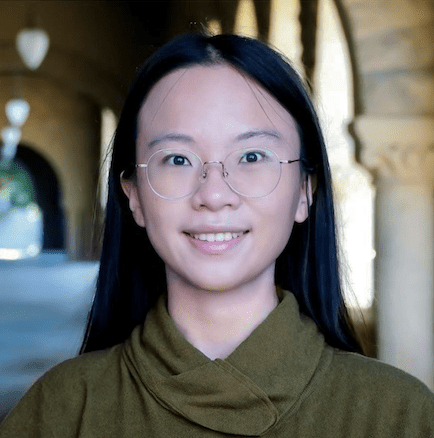
Yuchen Wu has joined Cornell Engineering’s School of Operations Research and Information Engineering as an assistant professor. Wu’s research sits at the intersection of statistics, applied probability, and artificial intelligence, focusing on establishing rigorous foundations for statistical and machine learning methods. Wu’s recent work explores sample generation with diffusion models, establishing theoretical foundations for high-dimensional statistical learning, and statistical inference based on machine-generated data.
Wu grew up in Wuhan, China, and as a child, her interests ranged widely. She played flute in an orchestra, took drawing classes, and enjoyed traveling with her parents. Mathematics was not an early passion. “I liked chemistry and biology a little better than math,” she said. “But my parents are math teachers, so they suggested math for my major.” That advice proved prescient. Wu took part in math competitions in high school and found the subject’s logic increasingly appealing. She completed her undergraduate degree in mathematics at Tsinghua University, where she also began exploring statistics. “I did some research in statistics with local professors and realized I enjoyed it,” she said. “That’s when I decided to apply for graduate school in statistics.”
Wu earned her Ph.D. in statistics at Stanford University, working with Andrea Montanari, whose lab bridges probability, high-dimensional statistics, and machine learning. “My advisor works on many things—statistical physics, applied probability, high-dimensional statistics, deep learning theory,” she said. One of her early projects involved posterior sampling using diffusion models, a class of generative models that power many of today’s AI tools. “We started by calling it a stochastic localization process, a concept from probability theory,” she said. “Then we realized it connects to generative models people use now. That’s how I began working in this area.”
At Cornell, Wu’s group studies diffusion models and the broader behavior of generative systems—particularly how large models interact with one another. “Different companies train different generative models,” she explained. “These models generate data that exist in the environment, and sometimes that synthetic data is collected by other models for training. I think of it as communication between models.” Her goal is to understand how that interaction affects estimation—whether it improves or harms it—and how statisticians can design frameworks to manage this new kind of feedback loop. “We can’t always tell whether data we find online was generated by a human or a machine,” she said. “So we need to think carefully about how to handle machine-generated data.”
Wu’s research also touches on fairness, bias, and the integrity of data sets. “We should look for clean data and for fair data that doesn’t contain bias toward certain groups,” she said. “That’s important when models start to train on synthetic information created by other models.”
Before joining Cornell, Wu was a postdoctoral researcher at the University of Pennsylvania’s Wharton School where she taught an undergraduate statistics course. “It was a very good postdoc position,” she said. “I only needed to teach one course, and it was a great experience.” In the Fall 2025 semester, Wu is teaching ORIE 6700, Statistical Principles, for Ph.D. students. “I’m making some modifications to make the material feel a little more like my own,” she said, crediting predecessor Christina Lee Yu for the excellent foundation of the course.
Wu chose Cornell for its collaborative environment and research breadth. “ORIE is a very good department,” she said. “People work on many different things—stochastic processes, applied probability, large language models. It’s a very open-minded and friendly place, and that’s good for the growth of junior faculty.”
Outside the classroom, Wu enjoys hiking and exploring Ithaca’s natural surroundings. “Cornell is a wonderful place for hiking, especially now that the weather is good,” she said. “I also like going to the farmers market, and I really want to try fruit picking.” She laughed about trying to convince her friends to join her: “They seem more interested in hiking.”
Despite her full schedule of teaching, mentoring, and research, Wu says she feels energized by the challenge. “Time management is something I’m still learning,” she said. “I wish there were 48 hours in a day. But I’m very happy. I’m busy, but I feel excited about everything.”