In 2025, Cornell engineers translated research ideas into real-world impact. Among other advances, they identified a key driver of pancreatic cancer and built the first “microwave brain” on a chip, opening new scientific frontiers in medicine and technology.
Faculty and students developed valuable knowledge and pushed boundaries. They found new ways to explore space and – a bit closer to home – demonstrated how policies like congestion pricing can improve air quality.
Whether they were leading the innovation of color-changing tomatoes or a neural implant smaller than a grain of salt, Cornell engineers worked to make a difference and to forge a better future.
Here are the most popular stories from 2025:
-
![rendering of Duffield Hall]()
Historic $100 million investment to expand Engineering’s Duffield Hall
A commitment, the largest in Cornell Engineering’s history, from David A. Duffield ’62, MBA ’64, will significantly expand the college’s existing Duffield Hall, creating a new state-of-the-art home for the School of Electrical and Computer Engineering and advancing ongoing investment in the spaces and people shaping Cornell Engineering’s future.
-
![conceptual image of data]()
‘Roadmap’ shows the environmental impact of AI data center boom
Engineers used advanced data analytics to create a state-by-state look at the environmental impact of the AI boom and how to make the computing infrastructure that supports it more sustainable.
-
![finger pointing at network web image]()
National Science Foundation announces Cornell-led AI Materials Institute
The National Science Foundation, in partnership with Intel, is investing $20 million over five years to establish the Artificial Intelligence Materials Institute at Cornell, which includes leadership from Cornell Engineering faculty.
-
![medical scan of a brain]()
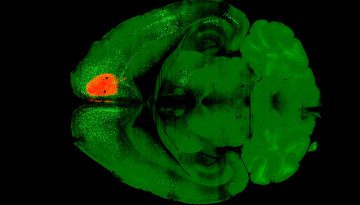
A dose of psilocybin, a dash of rabies point to treatment for depression
An international collaboration led by Cornell engineers used a combination of psilocybin and the rabies virus to map how – and where – the psychedelic compound rewires the connections in the brain.
-
![volcano in the middle of a lake]()
Magma found beneath dormant Cascade volcanoes
Research from Cornell Engineering upended the long-standing belief that active volcanoes have large magma bodies that are expelled during eruptions and then dissipate over time.
-
![two researchers examine a small device]()
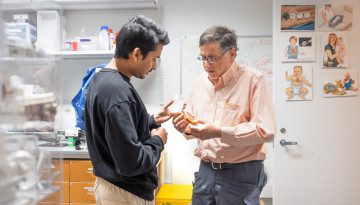
Research at risk: Life-saving heart pumps for babies
For much of the year, disruptions to federal research funding threatened projects across the university, including the development of a potentially life-saving pediatric heart pump. Many of these projects have since resumed, though getting them restarted is complicated. In the case of the heart pump, those lost months of work will add at least a year to the wait for the device.
-
![bill nye points to his watch]()
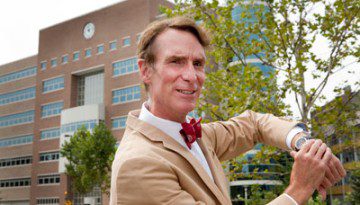
Bill Nye ’77 awarded Presidential Medal of Freedom
Cornell Engineering alum Bill Nye ’77, known by millions as “Bill Nye the Science Guy” and a tireless advocate for science education, received the Presidential Medal of Freedom, the United States’ highest civilian honor.
-
![a printer head prints a square object in liquid]()
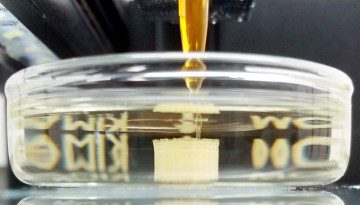
3D-printed superconductor achieves record performance
Nearly a decade after they first demonstrated that soft materials could guide the formation of superconductors, Cornell engineers have achieved a one-step, 3D printing method that produces superconductors with record performance.
-
![a metal box with photovoltaics on top]()
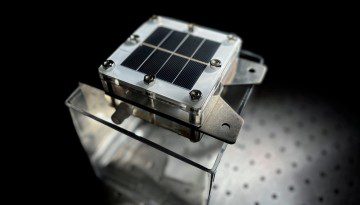
Sunlight and seawater lead to low-cost green hydrogen, clean water
Cornell engineers developed a low-cost method to produce carbon-free “green” hydrogen via solar-powered electrolysis of seawater – with a helpful byproduct: potable water.
-
![researcher uses a tabletop device]()
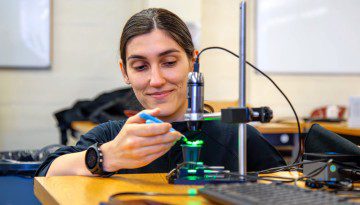
Century-old mystery of plant communication solved
Cornell engineers and other researchers at the Center for Research on Programmable Plant Systems have taken a major step toward advancing two-way communication with plants.