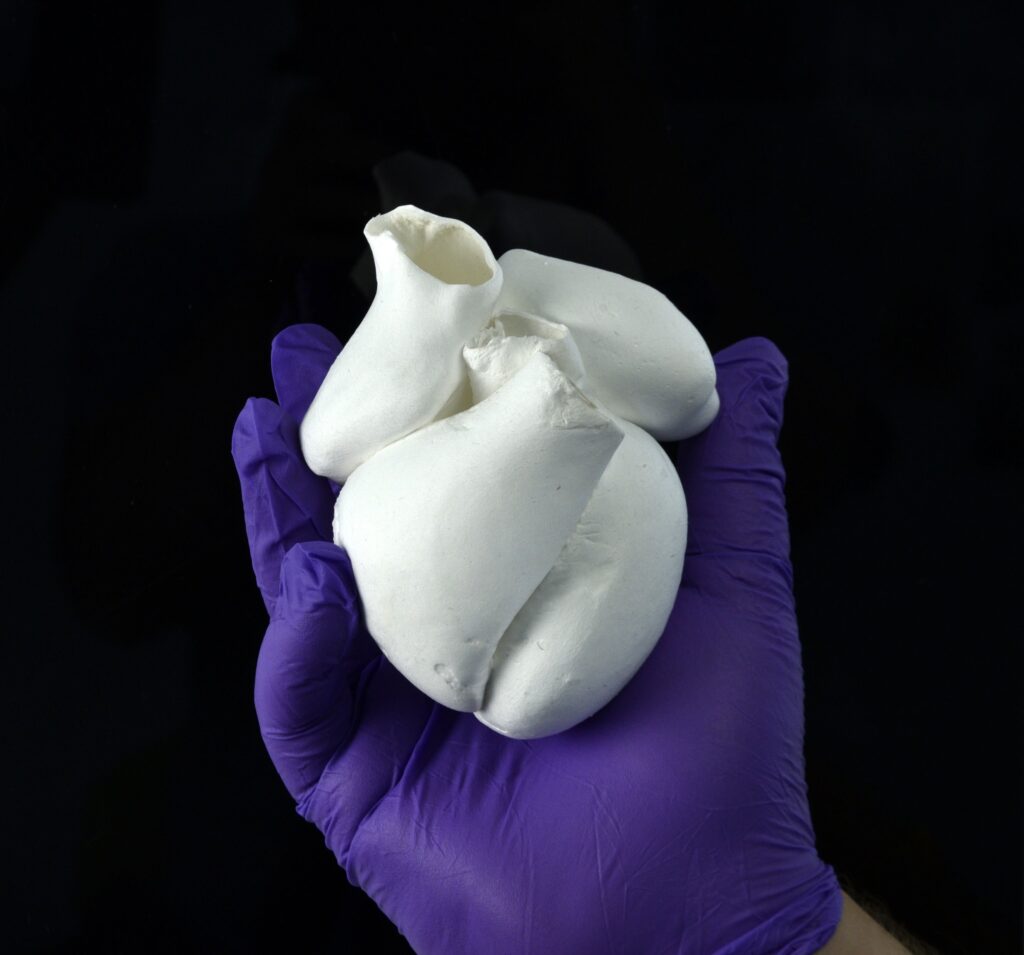
John Zimmerman joins the Meinig School as assistant professor in biomedical engineering starting in the fall semester 2025. He comes to Cornell from Harvard University, where he has been a postdoctoral fellow in the Disease Biophysics group in the School of Engineering and Applied Sciences. There, he developed models of the heart, using simulation software and machine learning to study how cardiac tissues deform and then building tissue-engineered systems to test these predictions.
Machine learning and tissue engineering are advancing the pace of biomedical discovery. Computational tools like physically motivated neural networks are being used to optimize models of complex living systems and can even help humans reverse-engineer biological design. Rebuilding these systems in a lab provides researchers with unique insights to tackle current problems in biomedical engineering.
The Zimmerman Laboratory at Cornell will study the interface between living and non-living systems and build models for understanding the fundamental structure-function relationships of the body. This includes using both computational and tissue engineered approaches to recreate emergent tissue scale phenomenon, focusing specifically on cardiac development, heart function, nanoparticle-cell interactions, and cardiomyopathies.
“I’m excited about using theory and design to develop new ideas about material science, chemistry, and biology. We can use the power of machine learning and simulations to predict the function of a biological system, then perform a real-life experiment to see if the two mesh. We either learn new biology or confirm our understanding of the world.”
Although his work focuses on the connections between physics, biology, and computation, Zimmerman has also been trained as a chemist. Zimmerman received his Ph.D. in chemistry from the University of Chicago. Prior to his Ph.D. he earned a B.A. in chemistry from Whitman College in Washington state.
Zimmerman is a Biomedical Consortium Scholar and has been a fellow on multiple National Research Service Award Training grants from the National Institutes of Health. Outside of the lab, some of his favorite hobbies include reading and video game development and design.