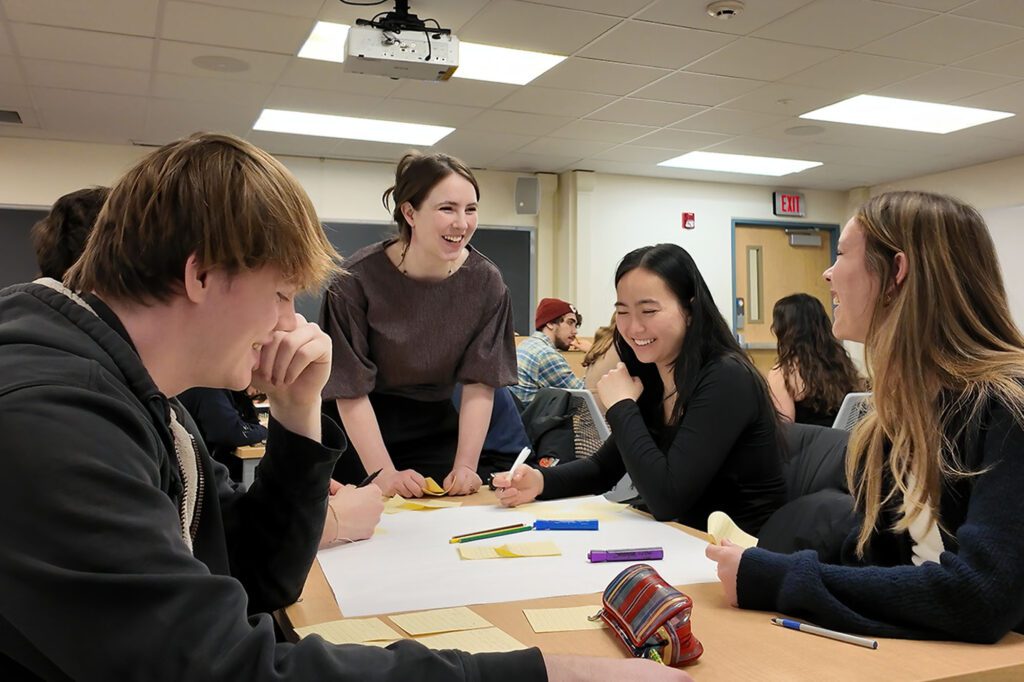
Engineering Education Research (EER) is transforming the Meinig School’s curriculum and setting a new standard for engineering education at Cornell.
What makes an effective engineer? It’s not just technical knowledge – it’s the ability to think critically, collaborate effectively and solve complex problems under uncertainty. That’s the driving question behind Cornell’s growing EER initiative, and the Meinig School is leading the charge.
Why Education Needs to Evolve
Biomedical engineering sits at the intersection of engineering and life sciences, preparing graduates to tackle urgent healthcare challenges through innovations in medical technologies, diagnostics and AI-powered tools. Yet, questions remain about how the field’s interdisciplinary nature is perceived and valued compared to traditional engineering disciplines.
The challenge is multifaceted. While women earn over 40% of degrees – one of the highest rates in engineering – systemic barriers continue to shape hiring and advancement. And as industry trends favor specialization, the school’s interdisciplinary strengths may be undervalued in the job market.
Engineering Education Research at the Meinig School
Alexandra Werth brings a unique perspective to these challenges. Originally trained in electrical and computer engineering, Werth shifted her focus to how students learn to think like engineers.
“Teaching doesn’t have to be trial and error,” Werth said. “We can study it. We can engineer educational systems to better support students in reaching ambitious learning outcomes.”
Now leading EER efforts, Werth applies the same engineering skills and evidence-based approach to education that engineers use to solve technical problems. Her work exemplifies Discipline-Based Education Research (DBER), using empirical methods to study and improve learning within a specific discipline.
Strategic Efforts Reshaping Education
-
Design-Centered Learning
Werth, along with assistant professor Nate Cira, secured consecutive grants from Cornell Engineering’s McCormick Teaching Excellence Institute in 2024 and 2025 to redesign key elements of the undergraduate curriculum. Their work restructured the introductory course, the experiential learning seminar sequence and the senior design capstone, embedding design thinking, active learning and flipped classroom models. The new modular online content now supports over 175 students annually across programs, including clinical immersion experiences and a partnership with Tuskegee University.
-
Mathematical Modeling
Professor Jonathan Butcher, with support from Cornell’s Active Learning Initiative grant to redesign core courses with emphasis on modeling and validation, is helping students master assumptions, sensitivity analysis and uncertainty – essential skills for connecting biology, physics and systems thinking.
-
21st Century AI Skills
Assistant professor John Zimmerman is developing a new course on neural networks to help students build fluency in data workflows and ethical AI use.
-
Collaborative Excellence
Werth’s team launched an AI-powered reflection platform that guides over 1,500 students through personalized teamwork reflections, offering insights for both students and instructors.
-
Ph.D. Scholar Development
Through GAANN fellowships, doctoral students are training as teaching scholars and redesigning course modules using evidence-based practices.
Celebrating Faculty Excellence
-
![Mridu Saikia]()
was recently named the school’s first teaching assistant professor, recognizing excellence in student-centered education and innovation.
-
![Alexandra Werth]()
will be awarded an EPICC Award from Cornell Engineering for innovation in recognition of her many contributions to engineering education research, both within the Meinig School and Cornell Engineering more broadly.