Stratospheric Aerosol Injection to cool the climate: what do we need to know?
To reduce the risks of climate change, it is essential to cut anthropogenic emissions of greenhouse gases such as CO2, and find ways to remove legacy CO2 from the atmosphere. However, at this point, it is clear that these tools will likely be insufficient to avoid significant climate damages. An additional option to consider is to reflect a bit more incoming sunlight back to space, for example by adding aerosols such as sulfate to the stratosphere. To make informed future societal decisions about this controversial approach we need to better understand what would happen, what the uncertainties and risks are, and enough about how to do it in order to answer those questions. In addition to describing our work to date at Cornell on design and on managing uncertainty through feedback, I will talk about what research is needed next, including designing atmospheric experiments to help resolve uncertainties in aerosol microphysical processes.
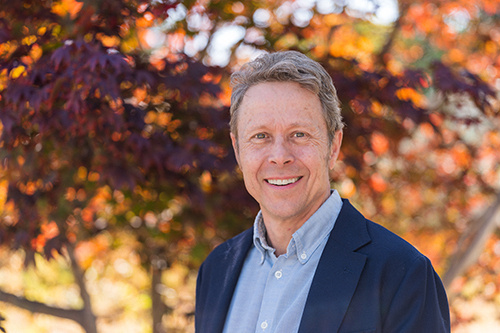
Bio: Douglas MacMartin is an associate professor in the Sibley School of Mechanical and Aerospace Engineering at Cornell University. His research focuses on sunlight reflection methods (also known as solar geoengineering or climate intervention) with the aim of helping to develop the knowledge base necessary to support informed future societal decisions. He has provided briefings to the United Nations Environment Program and testimony to the U.S. Congress and was a member of the U.S. National Academies panel that made recommendations on both research and governance in March 2021. He received his Ph.D. in aeronautics and astronautics from MIT in 1992; previous positions include United Technologies Research Center (1994-2000) and the California Institute of Technology (2000-2015). His research is funded by the Cornell Atkinson Center for a Sustainable Future, NSF, ARIA (UK), and the Quadrature Climate Foundation.