Data Driven Learning and Control seminar series is organized by the Information and Decision Science Lab at Cornell University and aims to explore the latest advancements and interdisciplinary approaches to data-driven learning and control systems.
Watch on YouTube Live
Learning and Control of Mixed-autonomy Traffic
Through advances in sensing, connectivity, computing, and electrification, the research community is engaged in shaping a sustainable and efficient infrastructure for moving people and goods. The current road infrastructure is significantly underutilized by today’s road users. In this talk, we will discuss how in a mixed traffic environment comprising connected and automated vehicles and human-driven vehicles, it is possible to gather rich, real-time data and exert distributed control, enabling unprecedented accuracy in traffic prediction and management. We will demonstrate how physics-informed machine learning techniques can be employed to develop robust, scalable traffic models that learn from and adapt to dynamic road conditions. These models facilitate proactive traffic control strategies capable of responding swiftly to unforeseen events and disturbances, ultimately improving traffic flow, safety, and environmental sustainability. We will highlight the comparative advantages of various machine learning model architectures. The presentation will feature experimental results and real-world demonstrations developed in collaboration with industry partners.
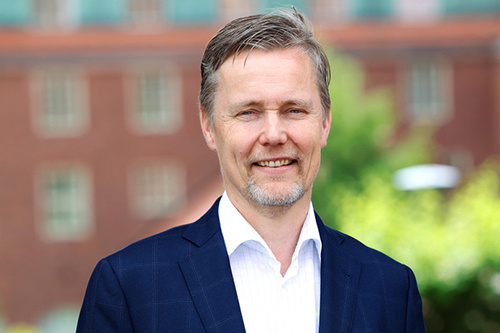
Bio: Karl H. Johansson is Swedish Research Council Distinguished Professor in electrical engineering and computer science at KTH Royal Institute of Technology in Sweden and Founding Director of Digital Futures. He earned his M.Sc. degree in electrical engineering and Ph.D. in automatic control from Lund University. At KTH he directed the ACCESS Linnaeus Centre 2009-2016 and the Strategic Ressearch Area ICT TNG 2013-2020. He has held visiting positions at UC Berkeley, Caltech, NTU and other prestigious institutions.
Johansson’s research interests focus on networked control systems and cyber-physical systems with applications in transportation, energy, and automation networks, areas in which he has co-authored more than 1 000 journal and conference papers and supervised 100 postdocs and Ph.D. students. He has co-authored or edited four books, 33 book chapters, and seven patents. For his scientific contributions, he has received numerous best paper awards and various other distinctions from the Institute of Electrical and Electronics Engineers, the International Federation of Automatic Control, and other organizations. He has been awarded Distinguished Professor by the Swedish Research Council, Wallenberg Scholar by the Knut and Alice Wallenberg Foundation, Future Research Leader by the Swedish Foundation for Strategic Research. He has also received the triennial IFAC Young Author Prize, IEEE Control Systems Society Distinguished Lecturer, and IFAC Outstanding Service Award. He was the recipient of the 2024 IEEE CSS Hendrik W. Bode Lecture Prize. He is Fellow of both the IEEE and the Royal Swedish Academy of Engineering Sciences.
Johansson’s extensive service to the academic community includes being President of the European Control Association, IEEE CSS Vice President Diversity, Outreach & Development, and Member of IEEE CSS Board of Governors and IFAC Council. He has been a member of the Swedish Scientific Council for Natural Sciences and Engineering Sciences. He has served on the editorial boards of IFAC Automatica, IEEE Transactions on Automatic Control, IEEE Transactions on Control of Network Systems, IET Control Theory and Applications, European Journal of Control, ACM Transactions on Internet of Things, and Annual Review of Control, Robotics, and Autonomous Systems, and currently serves ACM Transactions on Cyber-Physical Systems and IFAC Annual Reviews in Control. He was the General Chair of the ACM/IEEE Cyber-Physical Systems Week in 2010, IPC Co-Chair of the IEEE Conference on Decision and Control 2023, and General Co-Chair of the European Control Conference 2024.