Data Driven Learning and Control seminar series is organized by the Information and Decision Science Lab at Cornell University and aims to explore the latest advancements and interdisciplinary approaches to data-driven learning and control systems.
Watch on YouTube Live
Uncertainties in Deep Learning for Self-Driving Cars
Capabilities of self-driving cars has surged in the last 20 years, propelled by the promise that, in a very near future, commercial self-driving cars will be safe and perform well. Academia is spurring ground-breaking research (e.g. deep learning) and industry is validating software and hardware extensively with millions of miles being driven on the roads and in simulation. Yet, final adoption has slowed – primarily due to challenges such as weather and scaling. In this talk, I will present recent research at Cornell addressing these challenges. I will give an overview of the Ithaca 365 dataset, with repeated traversals over diverse scene and weather conditions; and a recent data collection from Hanoi Vietnam, with many scooters. I will then show several research directions that have built on these datasets, including learning via repeated traversals; transforming snowy scenes to sunny; and uncertainty quantification in deep learning.
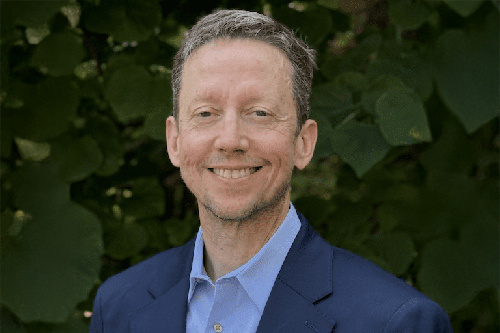
Bio: Mark Campbell joined the Sibley School of Mechanical and Aerospace Engineering faculty at Cornell in 2001 and is currently the John A. Mellowes ’60 Professor of Mechanical and Aerospace Engineering; he served as the S. C. Thomas Sze Director for the Sibley School in 2011-2019. Prior to Cornell, Campbell was an assistant professor at the University of Washington from 1997-2001. A graduate of Carnegie Mellon University (B.S.) and MIT (M.S., Ph.D.), he worked on MACE, a dynamics and control laboratory flown on Space Shuttle Endeavour in 1995. For the mission, his responsibilities involved the design of many of the 500 multivariable control experiments implemented on-orbit. As an academic, he has led research programs with strong impact broadly in aerospace and robotic systems, including control of flexible structures, formation flying spacecraft, student-designed and built satellites, cooperative UAVs, self-driving cars, and human-robotic teaming.
Campbell spent sabbaticals as a visiting scientist at the Insitu group, maker of small autonomous UAVs for commercial and defense applications; as an Australian Research Council International Fellow, working at the Australian Centre for Robotics (ACFR); and as a Visiting Scientist at Draper Labs. Professor Campbell was among a small group tenured faculty members across all disciplines in science and engineering selected for the Defense Science Study Group. He then served on the Air Force Science Advisory Board, for which he received the U.S. Air Force Chief of Staff Award for Exceptional Public Service.
Campbell has a passion for undergraduate teaching, with a focus on active learning and experiential projects. He has received multiple university and national teaching excellence awards including Cornell’s Stephen H. Weiss Presidential Fellow Award, Ralph S. Watts `72 Award, Douglas Whitney Award, Stephen Miles `57 Award, UW Aero Astro Professor of the Year award, Frontier’s in Education Young Faculty Fellow, and American Society of Engineering Education Teaching Award. Professor Campbell received best paper awards from the AIAA (two), CPS-SPC, Frontier’s in Education, and best poster award at the International Symposium on Distributed Autonomous Robotic Systems; he also received the Bennet Prize from CMU and is an Andrew Carnegie Scholar. He has served as an Associate Editor for the AIAA Journal of Guidance, Control and Dynamics and the IEEE Transactions on Aerospace and Electronic Systems, and Associate Director on the American Automatic Control Council Board of Directors (member of IFAC). Professor Campbell is a Fellow of the AIAA, IEEE and ASME.