Entangling quantum sensors, such as magnetometers or interferometers, can dramatically increase their sensitivity. In this talk, we will discuss how entanglement in a network of quantum sensors can be used to accurately measure one or more properties of spatially varying fields, including properties of spatially correlated noise.
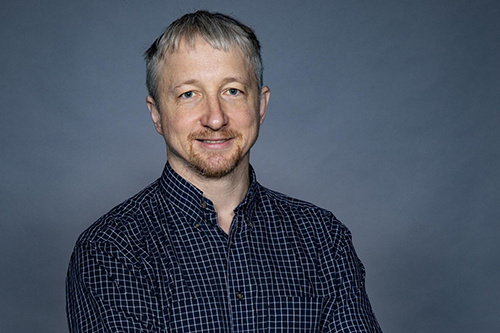
Bio: Alexey Gorshkov is an adjunct professor in the Department of Physics and the University of Maryland Institute for Advanced Computer Studies at the University of Maryland, and a physicist in the Quantum Measurement Division at the National Institute of Standards and Technology. He is also a Fellow of both the Joint Quantum Institute and the Joint Center for Quantum Information and Computer Science.
Gorshkov leads a theoretical research group focused on quantum information science, quantum optics, atomic and molecular physics, and condensed matter physics. His work aims to understand and control large interacting quantum systems and to design new ones. He earned his Ph.D. in physics from Harvard University in 2010
Originally from Russia, Gorshkov moved to the U.S. at age 15 and pursued his passion for mathematics and physics at Harvard. His research has contributed to quantum communication, computation, and simulation, including studies on photon binding and quantum entanglement. He is known for fostering strong collaboration between theorists and experimentalists.