Long-Range Electron Coherence in Kagome Metals
Materials that can host different states of electronic order form a recurring theme in physics and materials science, and they are of particular interest if the ordered states are coupled strongly. Recently, materials based on the structural motif of the Kagome web have attracted significant attention for their tendency to host such strongly coupled phases. In particular, the centro-symmetric layered Kagome metal (K,Rb,Cs)V3Sb5 have entered the focus of experimental and theoretical research. They host a charge-density-wave type transition at elevated temperatures ~100K, followed by a superconducting transition at 3K. Yet there is another type of electronic order which thus far eludes exact microscopic identification. A series of experimental probes detects the onset of anomalous behavior around T’~30-40K, including thermal Hall, mSR, NMR, magnetic torque, Kerr rotation. The anomalous low-temperature state carries the characteristics of a chiral, nematic and time-reversal-symmetry breaking fluid (all of which are under most active debate currently). The talk will focus on a recently discovered signature of long range electron coherence within this disordered multi-band semi-metal that evidences quantum coherence over long distances and at high temperatures. While conflicting with single-particle physics, it will likely find its resolution in a complex order parameter with the ability to carry current, akin to that of a superconducting state.
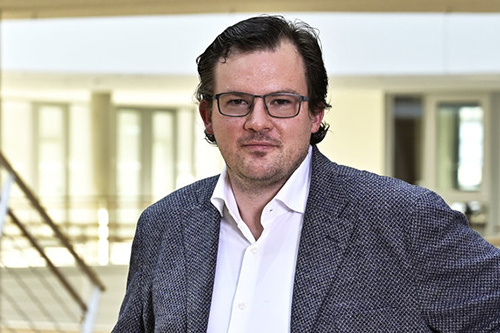
Bio: Philip Moll received his Ph.D. 2012 at ETH Zurich, Switzerland and followed that with a postdoc at ETH Zurich from 2012-2014. He was a researcher at the University of California, Berkeley until 2016 when he moved to the Max Planck Institute for Chemical Physics in Dresden, Germany, as head of the Physics of Microstructured Quantum Matter research group. In 2018, he took an assistant professor position at the Institute of Materials of EPFL and was head of the Laboratory of Quantum Materials. Moll has been a scientific member and director at the Max Planck Institute for Structure and Dynamics of Matter since 2021.
Moll has won the Nicholas Kurti Science Prize (2018) and the ABB Prize of the Swiss Physical Society (2014), and was selected as World Economic Forum Young Scientist 2020. In 2017, he received an ERC Starting Grant (2017) and a year later the Swiss National Science Foundation’s Professorial Fellowship.