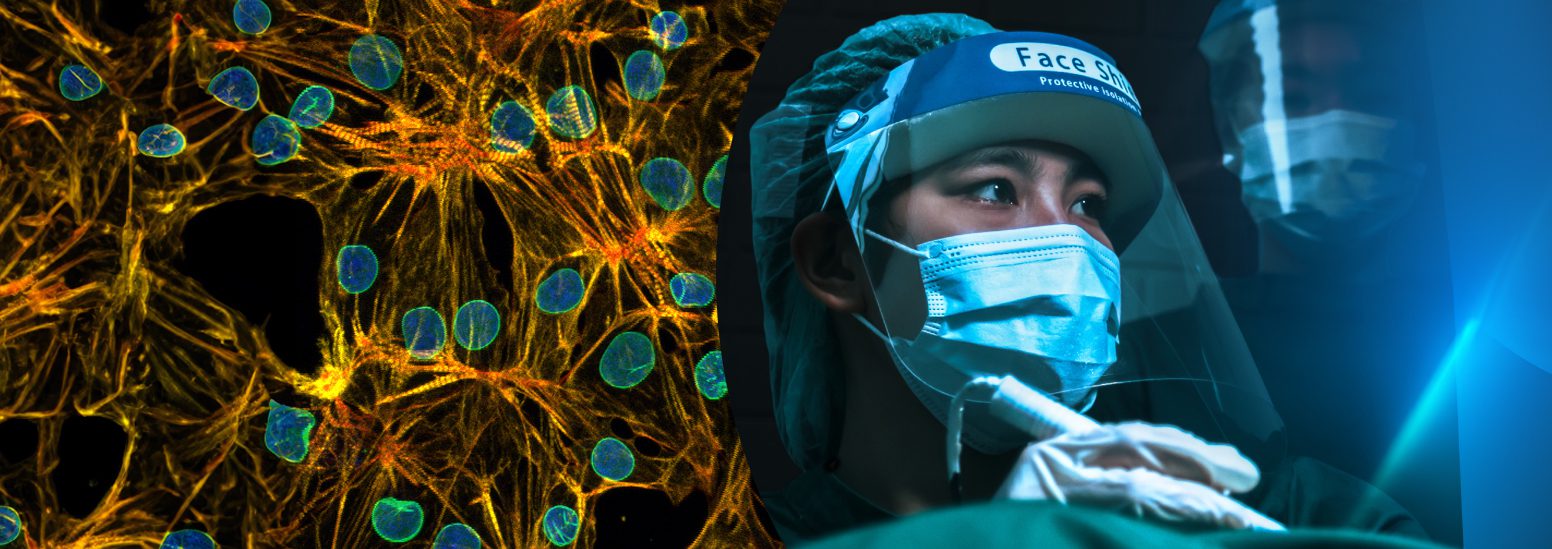
As medical fields experiencing rapid, revolutionary change, biotechnology sits at the sweet spot between engineering, physical sciences and life sciences, where it can leverage cutting-edge research collaborations. Building on Cornell Engineering’s long history of innovation in working with biological systems and developing solutions for diseases such as cancer, our efforts have the potential to transform current approaches to improving human health and make a meaningful impact on people’s lives.
-
3,000,000
People currently using a cardiac pacemaker, invented by Cornell engineer Wilson Greatbatch ’50.
-
2022
Year a human received the first 3D-printed ear implant, thanks to a company co-founded by engineering professor Lawrence Bonassar.
-
229
Miles between Cornell Engineering in Ithaca and Weill Cornell Medicine in NYC, two institutions that collaborate on research and programs.
-
5
School of Biomedical Engineering professors inducted into the National Academy of Inventors, more than any other school at Cornell.
Latest News
-
![RNA code]()
‘Stealthy’ lipid nanoparticles give mRNA vaccines a makeover
A new material developed at Cornell could significantly improve the delivery and effectiveness of mRNA vaccines – used to fight COVID-19 – by replacing a commonly used ingredient that may trigger unwanted immune responses in some people.
-
New biodegradable graft could help cardiovascular patients
The first-of-its-kind material not only expands and contracts like blood vessels but is also biodegradable; new vascular cells to grow around the graft as the body absorbs it.
-
Hitting the target: Imaging reveals psilocybin’s neural odyssey
Cornell researchers have identified a pair of key neurological mechanisms in the brain – a cell type and receptor – that enable the psychedelic compound’s long-lasting effects.

Select Centers and Facilities
- Center for Life Science Ventures
- Cornell Institute for Biotechnology
- Cornell Center on the Physics of Cancer Metabolism
- Engineering Innovations in Medicine
- MSKCC-Cornell Center for Translation of Cancer Nanomedicine
- Center for Point of Care Technologies for Nutrition, Infection and Cancer for Global Health
Select Programs
- Minor
- B.S.
- M.Eng.On Campus
- M.Eng.Distance Learning
- M.S.
- Ph.D.
-
Biomedical Engineering
Combines engineering with medical sciences to improve healthcare. Ideal for those driven to innovate in medical devices, diagnostics, and treatment technologies.
-
Applied Physics
Combines physics and engineering to develop technologies and solve scientific problems. Ideal for those interested in bridging fundamental science with real-world applications.
-
Engineering Physics
Combines engineering and physics to solve high-tech problems. Ideal for those interested in applying physics principles to developing innovative technologies.
-
Chemical Engineering
Focuses on transforming raw materials into valuable products through chemical processes. Great for those interested in industries like pharmaceuticals, energy, and manufacturing.
-
Materials Science and Engineering
Studies the properties of materials and their applications. Ideal for those excited about developing new materials for industries like electronics, energy, and healthcare.
-
Biological and Environmental Engineering
Combines biology, engineering, and environmental science to develop sustainable solutions for global challenges like food production, clean water, and renewable energy. It’s ideal for those passionate about sustainability and innovation.
-
Operations Research and Information Engineering
Optimizes complex systems using data and mathematical models. Ideal for those interested in logistics, decision-making, and improving processes.
-
Systems Engineering
Focuses on designing and managing complex systems. Ideal for those interested in coordinating processes to create efficient, scalable solutions for global challenges.