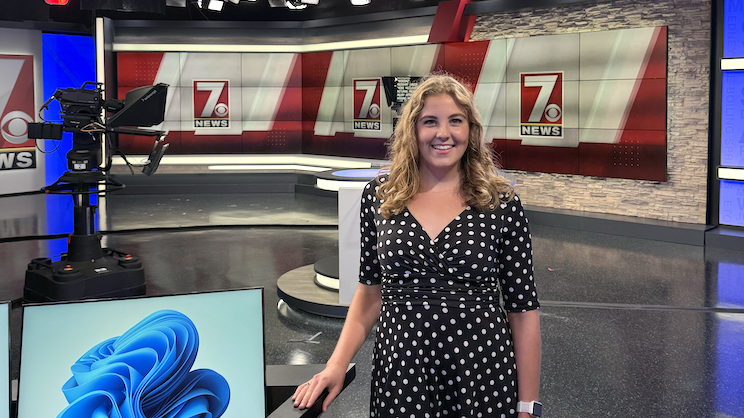
“I’ve always been an earth science nerd,” Nicole Collins said. “I remember going to the Grand Canyon when I was four years old and being absolutely mesmerized by the landscape and the rocks and everything. I like to say behind every meteorologist or weather nerd is a geologist nerd.”
Collins grew up in Morris County, New Jersey, in a home where she was encouraged to follow her passions. “My mom always drilled in me and my older brother: Do something that you like. Do something you’re passionate about. Do something that doesn’t keep you in the office every day and that is enjoyable.”
At one point, Collins thought geology might be her future. But as she began to think more pragmatically about career options, Collins understood that if she followed the geology path, it might lead her to a career that did not interest her as much as meteorology.
Part of her fascination with the weather is rooted in a powerful childhood memory. “I saw a building get struck by lightning when I was very young,” she says. “So then I had the worst phobia of thunderstorms growing up – full-blown panic attacks. I think because I was always obsessing about when a thunderstorm was going to come, as a way to make sure I would be inside and safe I got really interested in the science and became obsessed, in a good way.”
Like many aspiring meteorologists of her generation, Collins turned to technology to feed her curiosity. “The Weather Channel app – I had that on my phone with a whole slew of other weather apps,” she laughs. “As I think you’ll hear from a lot of meteorologists.”
Collins was applying to colleges during the 2020 COVID shutdowns and because of this her first interaction with anyone from Cornell’s atmospheric science program was a Zoom meeting with Art DeGaetano, professor of earth and atmospheric sciences. “I liked what he had to say about the program and Cornell became my top choice,” she says. “When I went to visit, I had that gut feeling of, ‘This is the place I want to be.’”
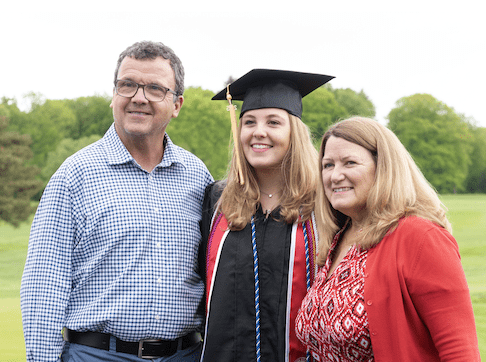
Collins took advantage of Cornell’s proximity to Ithaca College and their extensive infrastructure for people who want to learn how to be broadcast meteorologists. “It worked out well for them and for me,” Collins said. “Ithaca College doesn’t have a meteorology program and Cornell doesn’t have broadcast communications. So I got to learn how to be an on-air meteorologist by doing it. The first semester was really hard, but I stuck with it and went back for a second semester and that was much better. I learned a lot.”
Collins also appreciated the close-knit nature of the department. “It was a really supportive environment,” she says. “There weren’t a ton of us in the major, so you got to know everyone. The professors were approachable and wanted you to succeed.” Collins found the Cornell alumni network to be incredibly supportive and helpful. “Two of my biggest mentors are former CNN meteorologist Elisa Raffa and Nashville on-air meteorologist Danielle Breezy,” Collins said. Honorary American Meteorology Society Member and Cornell alumni John Morales ’84 is the person who introduced Collins to Raffa.
In addition to her time as the Ithaca College Television meteorologist, Collins was also the weekend weather person at Binghamton, NY, television station WICZ for almost three years as an undergraduate. After graduating from Cornell in May, 2025, Collins moved to South Carolina where she is now part of the team as a broadcast meteorologist at WSPA 7 News in the Greenville-Spartanburg-Anderson market.
In her new position Collins is having to acclimate herself to the weather patterns of a new place as well as to the new experience of being recognized in public. “I recently bought something off Facebook marketplace, and as soon as the people opened the door for me they recognized me,” Collins said. “And I’m teaching swim lessons on the side during my days off. One of my students is an older woman and she was like, ‘are you our new meteorologist?’ It still feels a little strange.”
Looking ahead, Collins is interested in continuing to grow her skills and possibly mentor younger meteorologists entering the field. She’s also interested in communicating science more broadly, making meteorology accessible to non-scientists. “I think there’s so much value in being able to explain things clearly to people who don’t have the technical background,” she says. “Especially when it comes to climate and extreme weather, it’s information that affects everyone.”
For students considering atmospheric science or environmental fields, Collins offers simple advice: follow your curiosity. “If you’re the kind of person who always wants to know why the sky looks the way it does, or why it rained over there and not here – that’s the spark,” she says. “Follow it.”