Printed Cooling Structures for Energy Efficient High-Power AI Chips: From lab scale to hyperscale
AI Data Centers are projected to consume 8% of the US grid electrical power by 2030 with the cooling consuming 3% of the US grid. The objective of our research is to develop an energy efficient two-phase cooling system for data centers to reduce cooling energy consumption from 40% to less than 5% of the total energy expenditure. Our technology also enables greater utilization of the processing power by reducing core throttling.
To achieve this objective, a novel additively manufactured two-phase wick structure and complementary manifold were developed. An enhanced cooling structure was printed directly onto the chip without thermal interface material (TIM) to achieve a low thermal resistance. A novel laser printed inter-material bonded to silicon by rapid formation of nm thin silicide. The wick structure was then printed directly onto the inter-material by rapid intermetallic bonding.
The porous and solid structure properties will be explored through microscopy (optical, SEM, TEM) and 3D CT scanning, mechanical and thermal testing. System thermal testing and reliability testing will also be discussed.
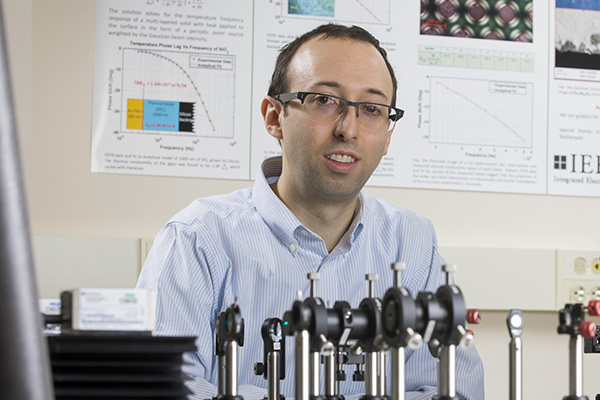
Bio: Scott Schiffres is an associate professor of mechanical engineering at SUNY Binghamton. Scott is pursuing a spinout through ChipAdd Corp. and with the backing of a 2025 Activate Fellowship. He is also the recipient of a 2019 NSF CAREER award in thermal transport processes. His research focuses on applications of heat transfer and additive manufacturing to electronics cooling and packaging challenges. Research in his group has been funded by NSF, ARPA-E, DOE, NIST, DoD, and industry.
Prior to joining Binghamton in 2016, Scott was a postdoctoral associate in the groups of Evelyn Wang and John Hart at MIT. Scott received his Ph.D. from Carnegie Mellon University, where he was advised by Jonathan Malen. Prior to going back to school for a Ph.D., Scott worked at Boeing’s Satellite Development Center for two years. Scott received a B.S.E. from Princeton University, and a M.Eng. from Cornell University.