Two-dimensional moiré quantum materials from strain engineering
Strain engineering in electronics has been widely utilized over the last 20 years in most standard Si-based CMOS fabrication processes. These process-induced strain engineering techniques, engineered from the nanofabrication process itself, are simple, reliable, applied device-to-device, and highly scalable down to the nanometer scale. In this talk, I will introduce our group’s work using process-induced strain engineering in 2D van der Waals bonded materials, and how these techniques may be applied to control moiré interference in twisted or non-twisted 2D systems. Applied strain in twisted 2D bilayers allows for designable control over the size and symmetry of moiré patterns. Similarly, applied strain in as-exfoliated non-twisted 2D systems allows for engineered moiré reconstruction from strain-induced lattice mismatch between layers. These techniques provide a pathway for the high-throughput fabrication of designer 2D moiré quantum materials, bringing along all the time-tested benefits of industrial scale reliability from conventional semiconductor manufacturing.
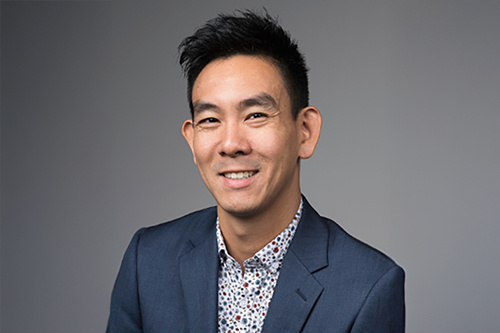
Bio: Stephen M. Wu is an associate professor at the University of Rochester in the Department of Electrical and Computer Engineering and the Department of Physics and Astronomy. His research interests involve engineering quantum materials to create novel electronic or quantum devices. He has won the NSF CAREER award, as well as the University of Rochester G. Graydon Curtis and Jane W. Curtis Teaching Award. Before Rochester, he was a postdoctoral researcher at Argonne National Laboratory within the Materials Science Division. He received his Ph.D. in physics, B.S. in electrical engineering and computer science, and B.A. in physics – all from the University of California, Berkeley.