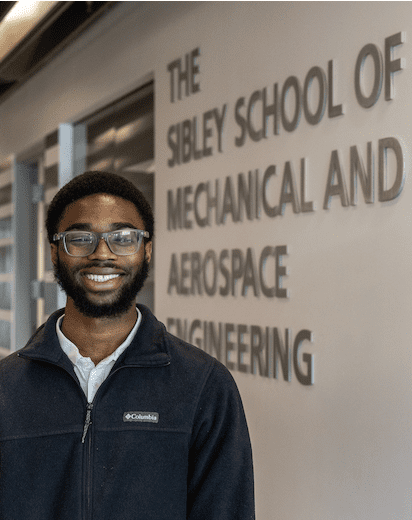
Growing up between Dallas, Texas, and Lagos, Nigeria, Benjamin Okoronkwo learned early to adapt to new surroundings and make the most of every experience. Now a junior majoring in mechanical engineering in Cornell’s Sibley School of Mechanical and Aerospace Engineering, Okoronkwo brings that same adaptability and creative energy to his work on campus.
“There wasn’t just one place I grew up,” he said. “And I think moving around taught me to be flexible and curious.”
At first, that curiosity led him not toward engineering, but toward the arts. “In high school, I was really into theater and choir,” he said. “Anything performing arts—that was my domain.” It was while helping build theater sets that he discovered how much he enjoyed creating things with his hands. “I think that’s what opened the door to engineering,” he said. “I realized I liked design and building just as much as performing.”
Though his father studied chemical and electrical engineering at the University of Texas at Austin and now runs a construction company in Nigeria, Okoronkwo said his own path to engineering was less direct. “I was taking physics and math because I found them interesting, not because I thought I’d major in them,” he said. “It just clicked later that mechanical engineering fit the way my brain works—I’m a very physical person, and I like to see how things come together.”
When it came time to choose a college, Cornell stood out. “I heard about Cornell from my cousin and started looking into the program,” he said. “I saw how strong it was, and the more I learned, the more I wanted to be here.”
Three years in, he says the experience has exceeded expectations. “It’s definitely challenging,” he said. “There have been moments when it’s hard, but I’ve come out of every semester with a sense of pride. The professors here really care about helping you understand what you’re doing.” Among those who have made a strong impression are Hadas Ritz (“She’s so passionate about Statics—she even brings in her old textbooks to explain concepts”), John Callister (“He brings so much life into class”), and Brian Kirby (“He knows every student’s name—that really meant something to me”).
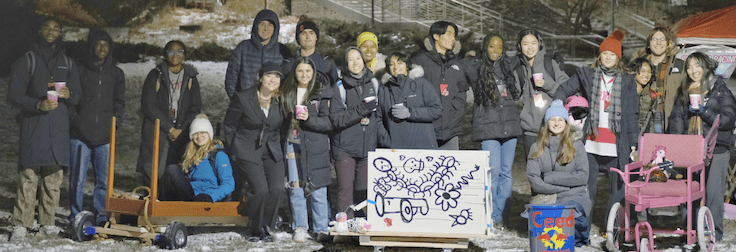
Outside the classroom, Okoronkwo channels his design instincts through hands-on projects. He works as a carpenter’s assistant with Cornell’s Department of Performing and Media Arts, helping to build stage sets for campus productions. But his primary creative outlet is the Cornell Entertainment Engineering and Design Club (CEED), which he now leads as president.
“I joined as a freshman, then became vice president and now president,” he said. “Each semester we take on a new project—it’s very fast-paced and focused on rapid prototyping.” Last year, the team built a robot; this year, they’re creating a physical, mechanical version of the classic arcade game, Flappy Bird. “It’s all about figuring things out on the fly, adapting when something doesn’t work—the founder calls it ‘the power of the pivot.’”
Managing the club has strengthened Okoronkwo’s leadership and design skills. “We use Fusion 360 for most of our design work, and I do the finite element analysis for the mechanical systems,” he said. “It’s taught me to think like an engineer—how to make something work efficiently and effectively.” The club’s projects often culminate in public demonstrations. “Last year we held an event called F1 Furniture, where we built and raced furniture go-karts on the Engineering Quad,” he said, laughing. “It was chaotic but so much fun.”
In addition to his work with CEED, Okoronkwo serves as a peer advisor for first-year engineering students, helping them navigate their first semesters at Cornell. “I really like talking to people,” he said. “Sometimes they’ll text me before their first prelims, asking for advice. I tell them: ‘You’ve got this. Just focus on what you can control.’ It feels good to help.”
Looking ahead, Okoronkwo envisions a future in product design and development. “I want to work on new technologies—phones, laptops, or anything that people use every day,” he said. “I love creating things from scratch and finding better ways to do them.”
He’s also drawn to entrepreneurship. “The club feels like a startup in a lot of ways,” he said. “We have to find funding, coordinate people, and build something new every semester. I like that freedom and creativity—I think that’s what I want in my career too.”
Though he no longer has time for theater productions, he still sees creativity as central to his engineering journey. “Making something new always feels like a performance in a way,” he said. “You imagine it, you build it, and then you get to see it come alive.”