Throughout the world, artificial intelligence is having a profound impact on how teachers teach, how students learn, and how researchers research – and Cornell Engineering is no exception. It is not an exaggeration to say that AI is reshaping every corner of modern engineering, affecting not just design and manufacturing but also what happens in the classroom.
In response, the Sibley School of Mechanical and Aerospace Engineering is building a curriculum that ensures its mechanical and aerospace engineers graduate fluent in the tools and mindsets that will guide the next era of the discipline.
Two of the faculty members leading this work, Guy Hoffman and Jian-Xun Wang, are partnering to accelerate the school’s efforts to bring AI into the undergraduate and graduate experience in meaningful, engineering-centered ways. Their complementary perspectives – Hoffman from robotics and human-machine interaction, Wang from scientific machine learning and physics-integrated modeling – are shaping a new vision for what an AI-infused mechanical engineering education can be.
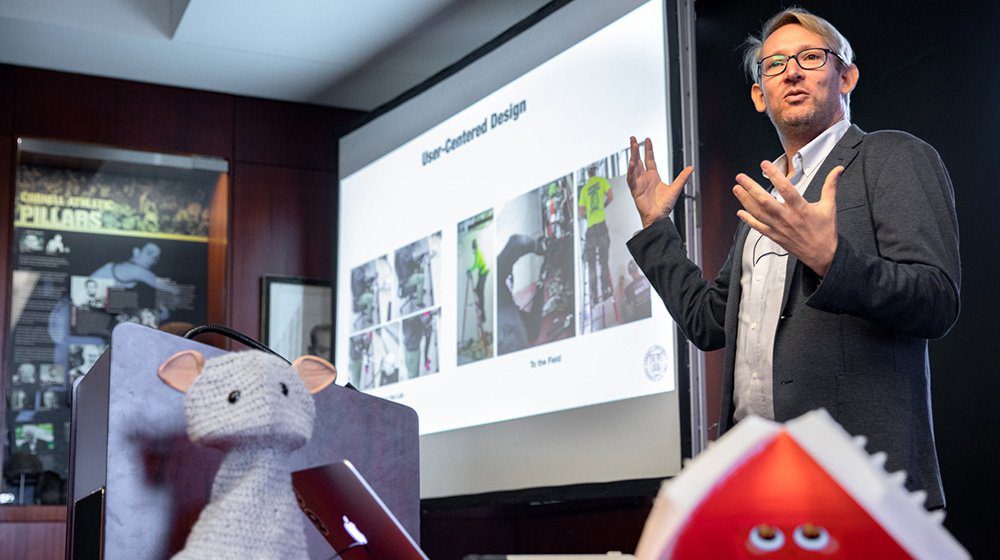
For Hoffman, associate professor and the Sibley School’s associate director of undergraduate affairs, AI belongs in the engineering curriculum not as an isolated subject but as a design and analytical tool students can apply immediately to real problems. Mechanical engineers are uniquely positioned to use AI creatively because they work at the interface of computation, materials, sensing, manufacturing and human experience.
Students are already using AI in their daily lives, but they need guidance in how to use it responsibly, effectively, and with an engineer’s understanding of failure modes and limitations. The goal is not to turn mechanical engineers into computer scientists. Instead, it is to empower them to understand deeply how AI operates and think critically about how it integrates into physical systems, design decisions and robotics.
This belief drives the content of a new course Hoffman is developing, a unique introduction to machine learning tailored to mechanical engineers. In this course, students learn both the mathematical theory behind machine learning and more applied skills, such as training engineering task-specific models. Crucially, students also interrogate AI’s shortcomings – bias, brittleness, unreliability and the need for human oversight, along with broader societal issues such as AI’s effect on the labor market, deskilling and intellectual property. In contrast to similar courses, Sibley School students will focus on engineering tasks and methods that are most appropriate for physical modeling and robotics, rather than images and text. Students will also discuss current events related to AI and machine learning to understand the broader impact on their lives and society at large.
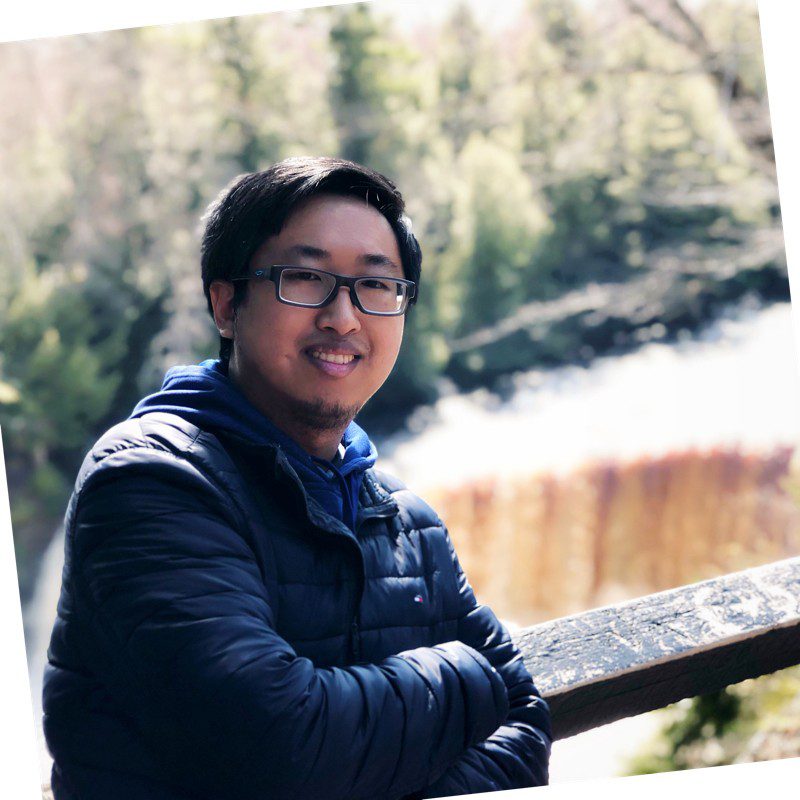
Where Hoffman focuses on the fundamentals, Wang’s work advances the frontier of scientific machine learning – a field that blends physics-based modeling with modern data-driven methods. “We want to teach models to respect the physical laws, so they don’t hallucinate,” said Wang, an associate professor. His approach integrates governing equations like the Navier–Stokes equations with machine learning architectures, producing “physics-informed” neural networks that maintain interpretability and reliability.
This philosophy shapes the new senior and graduate-level course he is developing, which will help students connect classical methods in thermodynamics, heat transfer and fluid mechanics to emerging neural-network-driven modeling approaches. Rather than treating AI as a black box, Wang teaches students to interrogate how different model architectures behave from a numerical analysis perspective, and how engineering principles can make them more stable, accurate and computationally efficient.
Wang’s research itself exemplifies the kind of AI-enhanced engineering he wants students to practice. His group develops physics-integrated, AI-empowered computational models that transform simulations once requiring weeks or months into near real-time predictive tools, fundamentally changing how engineers design, iterate and analyze systems. Applications span aerodynamics, thermal management, fluid-structure interaction, advanced manufacturing and even cardiovascular biomechanics.
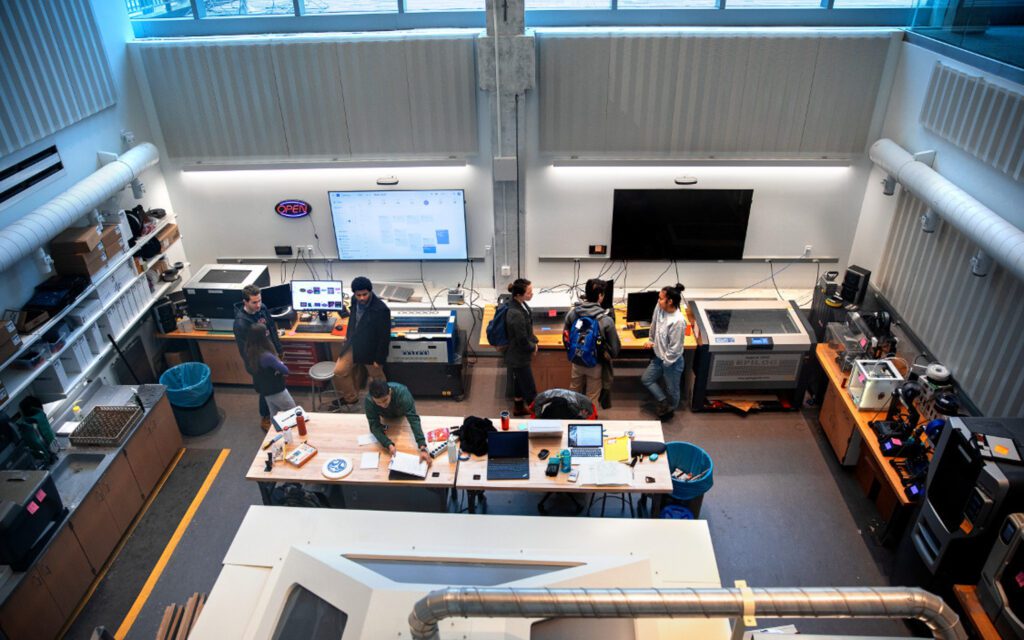
What makes the Sibley School’s AI initiative stand out is not simply the introduction of new classes but the deliberate integration of AI throughout the curriculum.
Kristopher Young ’06, M.Eng. ’07, chief operating officer at space manufacturing company Vast and current member of the school’s Advisory Council, sees the necessity of this effort. “The modern workplace will use AI methods in everything we do. It is important for Cornell to empower our graduates to become the pioneers and leaders that define how industry works with computation and AI,” Young said. “Embedding these methods into the curriculum throughout a student’s time in the Sibley School will provide a diverse exposure to problem solving and safe AI-driven thinking necessary for the 21st century.”
Hoffman and Wang are collaborating to create a connected sequence of undergraduate and graduate courses that introduces AI incrementally. Other faculty members in the Sibley School have expressed interest in expanding on Hoffman and Wang’s efforts.
Holly Rushmeier ’77, M.S. ’86, Ph.D. ’88 is chair of the Department of Computer Science at Yale and a member of the Sibley School Advisory Council. Rushmeier has been a vocal supporter of the school’s efforts to incorporate AI into the curriculum. “AI currently suffers from hype and reckless application of untested products,” Rushmeier said.
“Recent ML research though has produced powerful new computational approaches that are advancing engineering research and practice, when properly applied,” she said. “Students need to understand the various types of ML approaches, and where they can be beneficial and where they can be harmful.”
As AI becomes entwined with nearly every engineering domain, the Sibley School’s strategic investment in AI-centered teaching and research positions Cornell students at the forefront of technological change. By embedding AI across the curriculum, from undergraduate courses to advanced graduate seminars, the Sibley School ensures its graduates are not just competent users of AI but are capable of defining the future of the field.