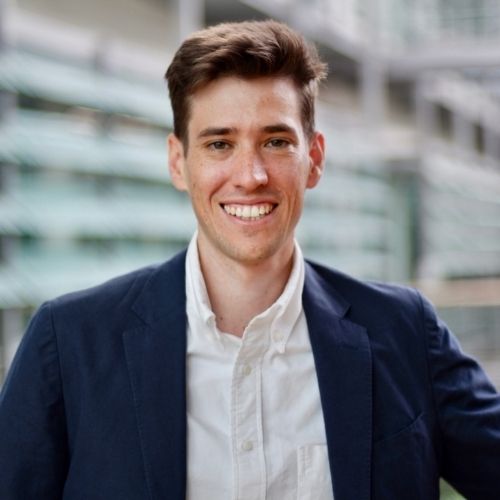
Biography
Matt Ferguson will begin July 1, 2026.
Matt Ferguson earned his Ph.D. in physics from Cornell in 2022. His doctoral work focused on using scanning superconducting sensors to visualize the electronic properties of superconductors and topological insulators. He then moved to the Max Planck Institute for Chemical Physics of Solids in Dresden, where he is developing techniques to probe and control the properties of superconducting and magnetic materials. He will join the Cornell faculty in 2026 as an assistant professor.
Research Interests
Research in our group revolves around developing new approaches for identifying and controlling the electronic properties of quantum materials. These materials exhibit behavior which is unavailable in the semiconductors, metals and insulators which make up the majority of our information processing devices. Quantum materials have the potential to enable both new energy-efficient devices as well as unlock fundamentally new approaches to information processing. Much of this potential remains untapped and research in our group is focused on unlocking the new electronic functionality promised by quantum materials.
- Uniaxial Strain Control
- Controlling the spacing between atoms in a material is a powerful way to control its properties. Accordingly, the application of strain or pressure to quantum materials provides a route towards systematically optimizing the electronic properties of a new material system. Our group utilizes piezoelectric uniaxial strain cells to explore the response of quantum materials to strain in situ down to millikelvin temperatures and in high magnetic fields. We bring a wide array of characterization tools, including transport, thermodynamic, and structural probes to bear in order to unravel the complicated structure-property relationships in quantum materials.
- Transport Phenomena
- Electronic transport measurements serve as a compass in quantum materials characterization, guiding us towards the discovery of new electronic states of matter. Emerging materials systems are often first synthesized as small single crystals. Our group utilizes micro-structuring techniques based on focused ion beams to sculpt high-quality single crystals into devices suitable for precision electronic transport characterization. Our approach allows emerging materials systems to be integrated with metallic, magnetic and superconducting thin-films, enabling proof-of-concept demonstrations of the new electronic behavior available in quantum materials.
- Thermodynamic Sensing
- Thermodynamic information—including magnetic, elastic, and thermal properties—offers deep insights into the nature quantum materials. Traditional thermodynamic measurement techniques are often limited by sample volume, making these measurements challenging in a broad class of materials with immense potential for technological applications. Due to these constraints, thermodynamic information is often missing precisely when the most reliable experimental input is needed. We are interested in developing techniques to extract thermodynamic information from micro to nanoscale samples. For example, we use superconducting sensors to conduct magnetic measurements thin-film samples, lamellae extracted from bulk single crystals, and atomically-thin van-de Waals heterostructures. We will also leverage our ability to micro-structure samples with thee-dimensional reliefs to fabricate micro-mechanical resonators from emerging materials systems, providing information about the elastic properties and the coupling of the electronic degrees of freedom to the lattice.
Select Publications
-
G. M. Ferguson, Run Xiao, Anthony R. Richardella, Austin Kaczmarek, Nitin Samarth, Katja C. Nowack. Visualizing the breakdown of the quantum anomalous Hall effect (arXiv: 2503.02633).
-
G. M. Ferguson, Run Xiao, Anthony R. Richardella, Nitin Samarth, Katja C. Nowack. Local potential distribution generates edge currents in a magnetic topological insulator (Physical Review B (2025).
-
G. M. Ferguson, Hari P. Nair, N.J. Schreiber, Ludi Mao, Kyle M. Shen, D. G. Schlom, Katja C. Nowack. Local magnetic response of superconducting Sr2RuO4 thin films. Physical Review B 110, 144510 (2024).
-
G. M. Ferguson, Run Xiao, D. Low, Ling-Jie Zhou, Anthony R. Richardella, Nitin Samarth, Katja C. Nowack. Direct visualization of electronic transport in a quantum anomalous Hall insulator. Nature Materials 22, 1100-1105 (2023).
-
G. M. Ferguson, Maja D. Bachmann, Florian Theuss, Tobias Meng, Carsten Putzke, Toni Helm, K.R. Shier, You-Sheng Li, K.A. Modic, Michael Nicklas, Markus Köning, D. Low, Sayak Gosh, Andrew P. Mackenzie, Franck Arnold, Elena Hassinger, Ross D. McDonald, Laurel E. Winter, Eric D. Bauer, Filip Ronning, B. J. Ramshaw, Katja C. Nowack, Philip J. W. Moll. Spatial Control of heavy-fermion superconductivity in CeIrIn5. Science Vol. 366, Issue 6462, pp.221-226. (2019)
Education
- Ph.D. physics, Cornell University 2022
- B.A. physics and mathematics, Washington University in St. Louis 2015