Harnessing Nature’s Solutions for More Efficient Biological CO2 Carbon Capture
Nature’s most prolific carbon-fixing enzyme, ribulose-1,5-bisphosphate carboxylase/oxygenase (Rubisco) is slow and poorly discriminates between CO2 and its competitive inhibitor O2. These catalytic limitations of Rubisco often limit plant growth. It has been proposed that Rubisco catalysis is constrained and cannot be further improved because of a strict trade-off between catalytic turnover rate and substrate specificity. However, this proposition has recently been overturned, the trade-offs are not as strict as once thought, but instead factors that have limited Rubisco molecular evolution have constrained Rubisco kinetic evolution. This new finding raises the possibility that there are “super Rubiscos” out there in nature waiting to be discovered. One lineage where such Rubiscos may be found is within the bryophytes. Vascular plants and bryophytes diverged from each other roughly 500 million years ago. Bryophytes have evolved under CO2-limiting conditions – creating the ideal selective constraint for evolving optima Rubisco enzymes that can be leveraged to develop new plant-based technologies to help mitigate effects of environmental change and to enhance food security. In addition to potentially kinetically-advantageous Rubiscos one of the bryophyte lineages, the hornworts, are the only land plant to have pyrenoids, which are a kind of membrane-less organelle that liquid-liquid phase separates Rubisco from the stroma. Pyrenoids actively concentrate substrate CO2 around Rubisco active sites, thereby greatly enhancing the efficiency of carbon fixation. Transplanting pyrenoids into other plants has the potential to improve C3 crop efficiency. In this study, we identified putative hornwort pyrenoid components using proteomics, and validated their subcellular localization using in vivo co-localization approaches to build the first spatial model of a hornwort pyrenoid. We also recapitulated the hornwort Rubisco biogenesis pathway in a custom-designed synthetic biology expression system, and used this to demonstrate that hornwort Rubiscos have divergent biogenesis requirements and dogma-breaking kinetic properties. The results of this study provide evolutionary, biochemical, and mechanical insights into the hornwort CO2-fixing machinery and make a first step towards gathering the requisite understanding to transplant hornwort Rubisco and/or pyrenoids into crop plants to boost CO2 fixation.
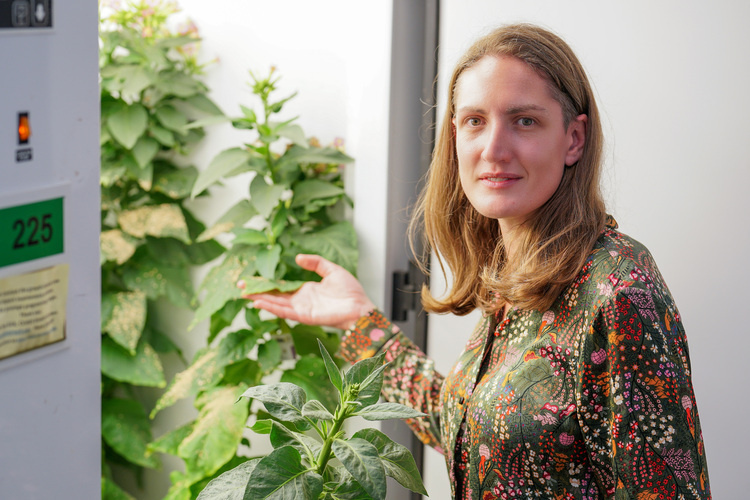
Bio: Laura Gunn received her Ph.D. in plant sciences from the Australian National University and conducted postdoctoral research in the laboratory of Molecular Biophysics at Uppsala University, Sweden. Since 2021, Laura holds an assistant professor position in the School of Integrated Plant Sciences at Cornell University. Laura Gunn works with nature’s vital, but notoriously inefficient, CO2-fixing enzyme, Rubisco (ribulose-1,5-bisphosphate carboxylase/oxygenase), whose catalysis often limits the growth and yield of crop plants. Her group is interested in the molecular mechanisms underpinning adaptation and acclimation of CO2 fixation to difference environmental conditions. She uses synthetic biology, structural biology and biochemistry to probe Rubisco biogenesis in vascular plants, develop blueprints for the biophysical CO2 concentrating mechanism in hornworts, and understand (and utilize) the catalytic influence of the auxiliary Rubisco small subunit.